

When a disabled body is new to you
By Louise Kinross
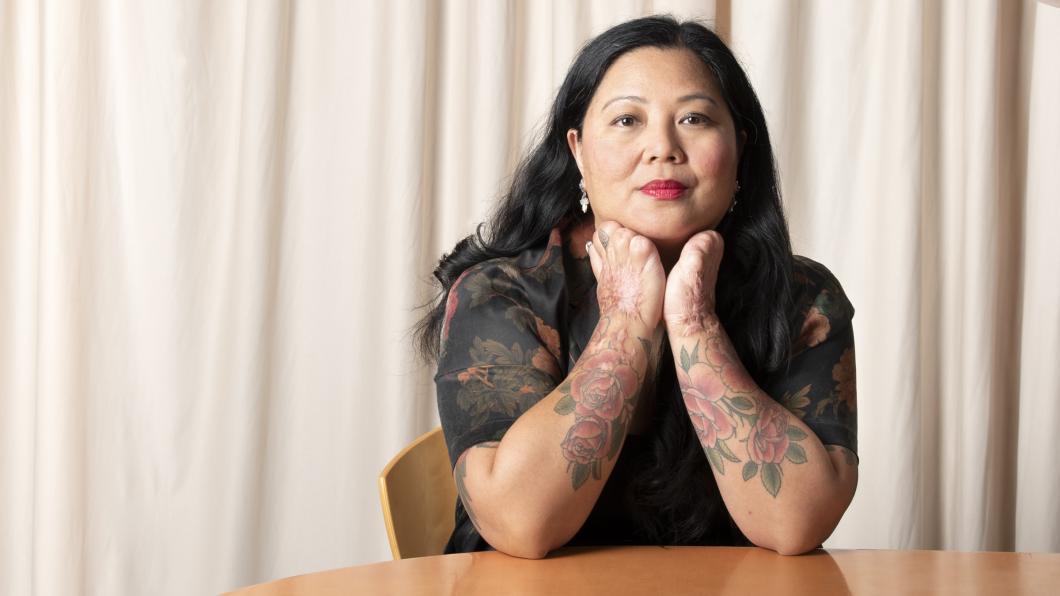
Jelly, Baby is a strikingly candid account of becoming disabled as an adult. Toronto poet and teacher Therese Estacion writes about her struggle to accept her new body after amputations saved her life from a deadly infection. She contrasts the fragile, jelly-like experience of her new identity in the face of ableism to her solid prosthetic legs, which initially feel like foreigners. She is training to be a psychotherapist.
BLOOM: You write about not feeling real when first wearing your prostheses. What did you mean by real?
Therese Estacion: Yeah, the word real. I wasn't born with a disability, so I acquired a disability through something traumatic. So my reality for 30 years was living in an able body and an able body that had body parts that were very real to me. And they were so real that I didn't even have to think about them twice, because I just did what I did. Like flex my ankles, right? Cut my nails. I just did all those things without having to think of it. That's how real they were. And so when I lost those parts, it became very surreal and my reality completely shifted.
There is that transition period where I didn't know what was real, what was not real. You know, like I had a hysterectomy. Was I still a woman, biologically speaking? What does it mean to be female?
I was thinking about these things, because I was going through a transition towards a different reality, a reality where I wouldn't be taking my former body parts with me. And my ability to do certain things, I wouldn't be able to take that with me to my new reality. So I think that's what I meant by real and not real.
BLOOM: In our culture who is considered real and who is considered not real, or less real?
Therese Estacion: Yeah, that's a great question. I think I was thinking about the word real and one facet of that would be the word rights, like who's given more rights in our culture? You know, there are disabled people who are very marginalized within the community.
These are folks with intellectual disabilities, even folks on the spectrum who are considered nonverbal, which is really erroneous because communication doesn't have to be verbal, right?
So, I was thinking about it in terms of who has been given more rights? Who is seen more as a whole person, not just like an infant? Because so much infantilization can happen.
People always say oh, we shouldn't have a hierarchy of disability. And I say, well, I don't ever want to ignore the fact that there are disabled people that receive more ableism.
I'm privileged. I live in the privileged end of the spectrum. I can shower myself independently. I can communicate my thoughts and have people take me seriously.
I’m thinking about whether the person sitting in front of you takes you in. Or are they just taking you in because they feel sorry for you, or they think they have a responsibility to take care of you, and not seeing you as a real person with desires and dreams and hopes?
BLOOM: In your book you talked about how you threw yourself into doing as a way of feeling more real. You were constantly doing things. It made me think how in our culture, capitalism is such a strong force, so we give value typically to people who are productive. When you were being super busy, what purpose did that serve?
Therese Estacion: I needed attention.
And the only way I could get attention is to be seen. And one of the things to do to be seen is to just be hyper-productive. And, you know, prove to other people that you could be of use to them.
I have something to show. I have something to give. I'm not a burden. I can do stuff too. I kind of hid the fact that I needed to be taken care of.
BLOOM: You write about initially resisting your new body. Your prostheses didn't feel like a part of you and you wanted to hide them under clothes. But over time you move toward a more accepting relationship.
Can you talk about that?
Therese Estacion: It’s still happening, you know. I think I accept my body more now because I'm grateful for it. Like I'm grateful for all the things that I can do with my prostheses. They’ve opened up my world completely.
But I'm aging as a disabled person and thinking about what it might mean to be a mom with a disability.
So, it's still happening, this question of how much do I reject my disability? As opposed to how much do I still need to figure out my relationship to my disability in different contexts and aspects of my life as an adult.
I think what really helped me was therapy. Going to therapy really helps. Having a supportive foundation, like family and friends and loved ones, helped because they weren't rejecting of me. They wanted to see me do well. They wanted to see me shine and they were really happy to be around me. So that ultimately gave me a lot of courage and hope within myself.
But that transition is not done. I think it's still happening. It's an ambivalence. I feel very ambivalent about my disability, which probably is where I'm always going to be. But I think I'd rather feel ambivalent than completely reject myself.
BLOOM: How did therapy help? Sometimes people with disabilities, or parents of disabled children, find it hard to find a therapist that they feel understands their experience.
Therese Estacion: I can tell you that the school that I go to has an amazing training program. It's called the Centre for Training in Psychotherapy. We even have a low-cost therapy program.
The key is to find somebody who is very well trained. You can do different consultations, or you can ask for a pause and really reflect on if this is the right route for you.
I did psychodynamic psychotherapy. It's talk therapy that focuses on many things, but one of the foundations is trying to determine what's living in your unconscious.
BLOOM: In your book you talk about the role that rage played in your journey.
Therese Estacion: I think it's just a normal human emotion. It depends on who you are. It can turn inward and then you become sick, you become depressed. I'm more of an outward person when it comes to rage. So it pushes people away. I needed to learn how to be rageful but not be lonely. When I was able to talk about it and not be so reactive, I found that it made people want to explore their own rage, or it made my work more relatable. I wanted to give myself permission to rage.
There are so many things that happen when you're disabled that feel, in terms of ableism, very passive aggressive from the other person. And I thought, why am I protecting these people? Like, you made me angry, so I will write about this, or I will tell you that that's not okay. And how they respond is up to them.
BLOOM: In one of your chapters, you talk about extreme incidents of ableism. I like that you call it a form of violence. Has the way you respond to ableism changed over the years?
Therese Estacion: In the beginning I was so happy to be out in the world and excited to show off my new body. And then I would get all these looks, and it felt so invasive, so I became very defensive.
Then all these experiences started happening, really intense prejudicial stuff. I distinctly remember at a wedding, someone saying to me, ‘How did you get with your partner?’ Like, how could someone like that be with you?
But through my training program, [I learned] that they were projecting their self-hate onto me. That's how they feel about themselves—the fear that they have of potentially not finding a partner, for whatever reason, or the fear that they have of being disabled themselves. That's their own journey, not mine.
Back in the day, I thought it's all me—you know, there's something wrong with me. But now I'm able to distinguish what's mine and what's really not mine.
For example, maybe I feel more vulnerable when I'm walking in public because I just want to sit and not have people look, you know?
That's mine.
I can distinguish between that and someone really staring hard and coming up to me and asking, ‘Hey, what happened to you?’ And sensing, oh, that's a fear that they have of something in their life that doesn't belong to me anymore.
So that feels important. To be able to ask oneself: is this mine or is this theirs? Or is it both of ours?
BLOOM: If you were talking with a newly disabled person, would you have any advice?
Therese Estacion: Yeah, for me, it's know that you're not alone.
I think that's really important. The disabled community is so large and it's so vocal, right? Like if you look at disability advocates that you can tap into, there's a spectrum of them. From Alice Wong and Stella Young, who have passed away, to Spencer West, who talks a lot about accessibility, to Andrew Gurza, who talks a lot about eroticism.
Just know that you're not alone and that there are resources that you can connect to and feel safe around, even if you can’t find a therapist.
BLOOM: In children's rehab, parents are encouraged to help their child practice how they explain their disability, so they feel confident answering questions. There’s even a children’s book called Just Ask, which suggests kids ask each other about their differences. But I’ve noticed a pushback to this from disabled people.
So I laughed in your book when you describe children who ask you relentless questions as entitled brats.
Therese Estacion: Unfortunately, we cannot control other people's behaviour, but what we can do is know that we have our own personal choices. Like, if we want, we can share. If we don't want, we can just say, listen, that’s not something I want to talk about right now, or I’m busy.
I just saw a video of Spencer West where he said that he will tell people: ’I don't feel like telling you my story. You're a stranger to me.’
For little kids, I think it's foreign for them to know that they have a choice, depending on how they feel and on the context. Because what if it is a friend that they love and trust and they want to say, ‘Yeah, this is what happened to me.’ Then that's fine.
BLOOM: How can we teach children who don’t have disabilities about boundaries, and respect for a person’s personal story.
Therese Estacion: I think it's important to educate kids at a very young age about biodiversity. Like they’re asking, why are there differences? Why is that butterfly this colour? Why is there a huge snake that's called an anaconda versus a garden snake? Because there are different kinds of snakes, there are different kinds of insects.
Some people are born with disabilities. Some people acquire disabilities at a later age because of trauma or because, you know, a certain gene just ends up becoming more alive.
To normalize biodiversity for kids is so important.
To introduce the word ableism at a young age is important. We need to explain that what makes disability so painful and othering is ableism. How can we talk to kids about ableism? I think that would be an important shift.
BLOOM: I like the definition of ableism I read in Demystifying Disability by Emily Ladau. She said when people make excuses about a lack of accessibility, what they’re really saying is disabled people are unwelcome here. Ableism makes disabled people feel unwelcome.
I think young children could understand that there are ways that we help people feel welcome, and there are ways that hurt people, because it makes them feel unwelcome.
Therese Estacion: Also, kids want to make friends. Ableism is unfriendly. If you're creating material for really young kids, looking at friendships.
BLOOM: I love the way you likened the disabled experience to jelly and talked about being a disabled jelly baby. At one point you talked about hating your tenderness. As humans, why do we give so little value to our tender, wobbly, fragile nature?
Therese Estacion: I can only speak for myself, but I think it's experiences with rejection, you know, from an early age. It's scary to be vulnerable. It's the asking of help and regard and knowing that someone can say no.
That's the big question: Like, oh my God, if they say no, what am I left with? I think that is the very scary part of being tender. Knowing that someone might say, I don't care about that. That can feel very painful.
Or, you might have a plan for the day to go to this coffee shop and you go and you can't enter.
BLOOM: Yeah, no disabled people allowed here.
Therese Estacion: I think that was the question going back to my entrance interview [for psychotherapy school]. I was asked: ‘Have you ever thought about what [clients] would think about your body?’ That question lives in this world where there are no disabled clients.
BLOOM: There's been so much research about how little medical students learn about disability from the medical and human perspective, and their own bias.
Therese Estacion: Well, the tradition the medical field comes from is really one where disabled folks were experimented on. So there was even more violence to begin with. That’s the foundation of it.
BLOOM: What do you think about the term disability pride? Should that be part of rehab?
Therese Estacion: I don't know how I feel about that word pride. It feels like a band-aid word sometimes.
Also, when I was in rehab it was interesting that these events were planned for the hospital’s disabled patients and residents. But all the decisions were made by able-bodied people. I had the privilege of sitting on a couple of these planning committees, but always at the end, so they could tick off a box that said there was a disabled person here.
The ideas that they had were so counterintuitive and even harmful.
For example, they were breaking ground for a new building and they were going to invite the premier, and someone on the team said why don’t we have smoke machines? I said but you have respiratory patients here who use ventilators. Why would you ever have smoke machines?
They also had huge foundation nights where they had charity basketball and ex-NBA stars would come and play. They would have a very fancy kind of cocktail night where they were auctioning off all these expensive pieces.
They didn't invite any of their disabled patients, other than me and one other person. Everyone else was able-bodied. So they’re raising money for disabled people, but disabled people aren't even present. It's this weird disconnect.
Disabled people weren't even invited to watch the basketball games. And that could have been an easy fix. You know, you rent a big van or a bus, ask who wants to come, and the facilities are at the University of Toronto, so you can create an accessible area. But they didn't want people to see disabled patients because their motto is ‘Get Your Life Back.’
They're raising money to show that you can go from having a disability to not having a disability: from being someone who needs a lot of care and tenderness, to being hyper independent. I was one of those patients that presented as hyper independent, as this productive person that can contribute.
I was invited, but they didn't like it when I said to them, ‘Hey, how come other disabled people aren't here? What's going on?’
BLOOM: For professionals reading this, what kind of care did you find affirming and empowering and helpful?
Therese Estacion: I had a really awesome doctor, Dr. Dhillon. He was so great. And I had amazing nurses and an amazing spiritual care person, Steve Hudecki. What they did was they listened to me. They wanted to get to know me as a person apart from my needs as a disabled person.
They believed me when I said: ‘Hey I’m in pain, I cannot do this right now.’ They believed me when I said ‘The night nurse told me she was going to put me on a sleep schedule. That’s infantilizing.’ They respected my right to privacy, and they respected me as a person. They took the time to listen.
You can learn more about Therese Estacion in the video series Postcards From… as she travels across Canada to find out how accessible her adventures can be. Like this content? Sign up for our monthly BLOOM e-letter or take our short BLOOM survey.