

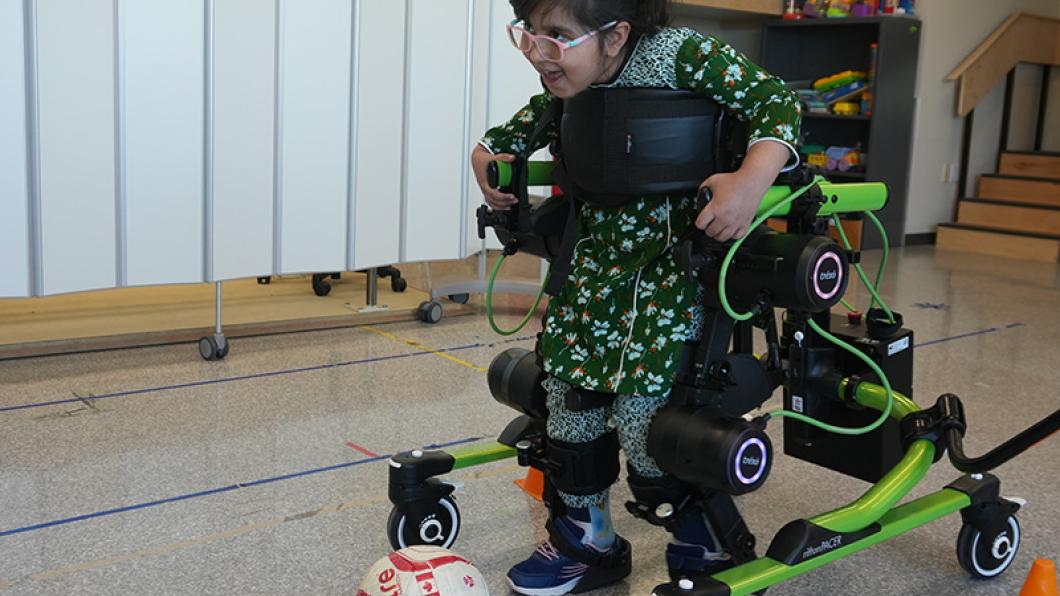
Learning how an exoskeleton robot helps kids with cerebral palsy
Cerebral palsy (CP) is the most common physical disability for children in Canada, affecting more than 15 per cent of Holland Bloorview clients.
Thanks to donor support, kids and youth with CP and other conditions that limit mobility have access to the Trexo, a Canadian-made robotic exoskeleton frame that attaches to a walker and powers their leg movements, allowing them to stand upright and move around.
A study led by Dr. Tom Chau and Dr. Virginia Wright at the Bloorview Research Institute in 2023-24 found that Trexo therapy was safe and comfortable for kids and could lead to better walking. Parents also reported that kids using the Trexo experienced improved speech, hand dexterity and ability to walk. As well, MRI scans afterward revealed incremental structural changes in their brains, suggesting that Trexo may promote neuroplasticity, the ability of the brain to adapt and change. And feedback from the participants was overwhelmingly positive. “One thing that’s obvious to see is the happiness she experienced using the Trexo,” one client parent reported. “Another is having more independence. She feels more in control, and you can see it.”
Dr. Chau determined that more research was needed to investigate the effects of the Trexo on both the bodies and the brains of clients with CP.
Now, thanks to a $350,000 gift from FDC Foundation, he is supervising two graduate students in his PRISM lab, Marita Cafazzo and Yara Corky, as they conduct new studies investigating the exercise benefits of the Trexo and what happens in kids’ brains while they’re using it. Both are currently recruiting participants.
“These are early-stage studies that are difficult to get funded,” Dr. Chau says. “It would probably take years to secure the funding, so I’m grateful that we can jump-start that process.”
The first study will provide information about the energy requirements of walking in an exoskeleton. “I believe nobody has done research on that, at least not in kids with CP,” says Dr. Chau. “In our initial study we observed that most kids were extremely tired after doing therapy with the Trexo. It’s not what you’d expect—since a robot is helping the child move their legs, you’d think there’d be minimal energy expended. So we want to understand whether this can actually be a form of cardiovascular exercise for these children, who have very limited exercise options.” The results will help therapists create personalized exercise and dietary plans for clients, leading to improved health outcomes.
The second study will use electroencephalography (EEG) to measure brain activity during Trexo use in order to improve understanding of motor control and neuroplasticity in children with CP and help develop customized interventions. “We want to understand what the brain is doing, because that’s not clear when you have a robot helping you move your legs versus intentionally controlling your muscles,” Dr. Chau says. “This research may suggest that certain types of exercise are particularly beneficial for maximizing brain plasticity, which could help match exercises to individuals’ goals.”
This study also has exciting potential to allow kids to control the Trexo themselves. “If we can understand the brain patterns during exoskeleton use, we can do early detection of the intention to move, and use those signals to drive and control it,” Dr. Chau explains. “To really maximize brain plasticity we need the child to be controlling the robot. That way the brain receives the feedback quickly enough to strengthen and reconfigure its connections. So this study can set the path for eventual brain control of the exoskeleton, using BCI [brain computer interface] technology.”
FDC Foundation’s gift is also providing an essential piece of equipment for the PRISM lab’s work: a circuit mill that lets researchers design and prototype their own electronic circuits. Since the previous device broke down, the lab has been sending designs to a manufacturer in China and experiencing long delays in shipping back and forth. “We need to create these circuits for a lot of projects, including BCI, the Trexo studies and more,” says Dr. Chau. “So we urgently need a new one to keep doing our work.”
Dr. Chau is thankful for FDC Foundation’s significant and timely gift to fund the equipment and studies that could spur further research to benefit more children with CP. “This support is very important, because funding agencies want to see pilot data that show a new technology is effective, and that’s hard to generate without funding,” he says. “At the very least, these studies will provide that early evidence so we can apply for larger government grants. So we’re very grateful.”