
Canada’s first Accessible Digital Donor Wall is unveiled at Holland Bloorview
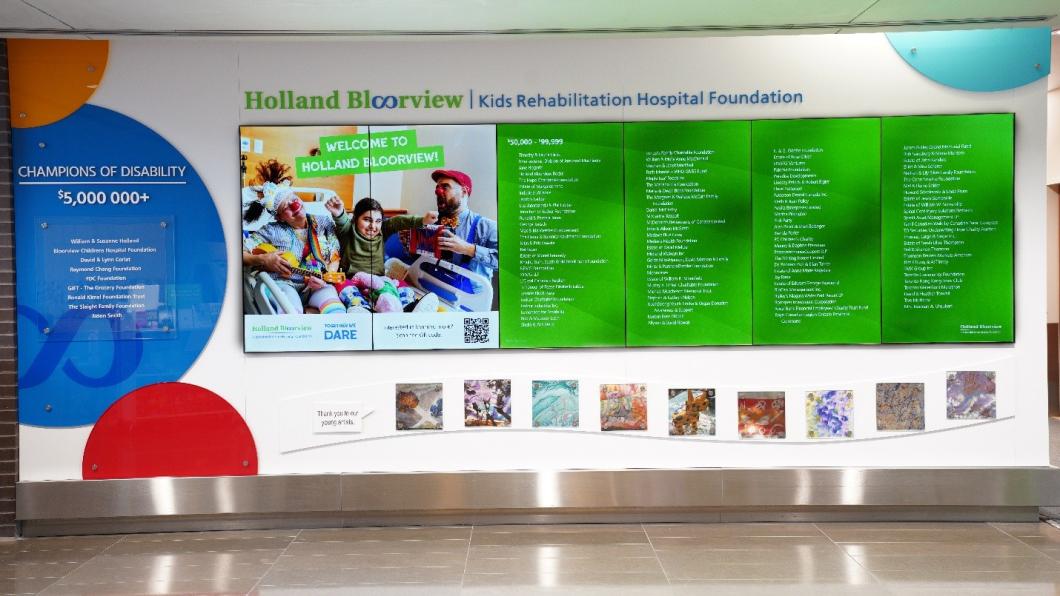
There’s a dazzling new feature that staff and visitors will notice as they enter Holland Bloorview: Canada’s first accessible Digital Donor Wall. It’s a bright, colourful installation that recognizes our generous donors.
We wanted to ensure that we used this opportunity to create something never done before that could also inspire increased accessibility across the sector. Developing the Digital Donor Wall was a collaborative effort led by the Holland Bloorview Foundation in consultation with staff, clients, families, volunteers and community members with lived experience of disability. A Donor Wall Working Group was formed that included Holland Bloorview Family Leaders, Youth Leaders, a volunteer, a scientist, an autism advocate, the Inclusion, Diversity, Equity, Accessibility and Anti-Racism (IDEAA) office and a designer to advise the vendor, Digitality Solutions.
Tasked with maximizing the wall’s accessibility, the group considered factors like the installation height, the screens’ brightness and colour contrast, the font size of the text and the speed of the slide rotation in order to accommodate users with visual, mobility, cognitive or other differences and ensure it reflects Holland Bloorview’s accessibility and equity goals.
This innovative Donor Wall features a list of donors, as well as multiple screens displaying a changing array of videos, client and donor stories and artwork created by Holland Bloorview clients. Click here to watch a video about the development of the wall and the aims of the working group.
Moira Robertson is an autistic adult who served on the working group. “Nine times out of 10, you go out into the world and it’s not accessible,” she says. “There are things that make your day stressful, and screens are one of them. Sometimes there are weird moving parts or ads that take my attention away and overwhelm me when I’m trying to focus. So it was nice to see those things being considered.”
Adds fellow working group member Maddy Dever: “I appreciate how my lived experience was actively sought and genuinely integrated into the design. It felt like true co-design, ensuring the donor wall would be accessible to as many kids, families and visitors as possible.”
“Our primary goal was to make a sensory-friendly wall that is as informative as it is welcoming,” says Dr. Tim Ross, a BRI scientist and another member of the working group. “We considered many ways to make this wall as accessible as possible for a variety of visitors.”
The group discussions led to enhancements in the screens’ font size and style, colour contrasts, Braille instructions, a QR code to link to an accessible donors list webpage, and the improved timing of display content changes. “Incorporating a display for children’s artwork created a joyful way to include children and celebrate their creativity alongside donor contributions,” Dr. Ross says.
The wall both thanks donors and welcomes visitors into the Holland Bloorview community. "Traditional philanthropy has often overlooked the idea that donors might be part of the community they support,” says working group member Lorraine Thomas, manager of IDEAA at Holland Bloorview. “Implementing this accessible wall sends a strong message that every donor's contribution is valued, without making assumptions about their community involvement."
Greg Contaxis is a longtime volunteer at Holland Bloorview who also participated in the working group. “I believe it’s important to show people who come into our facility who has donated, and how grateful we are,” he says. “And it’s important for families, clients and volunteers like me to see the wall in action, because it shows Holland Bloorview as a leader and innovator.”