
How Holland Bloorview provides personalized care for children with spina bifida
June marks National Spina Bifida and Hydrocephalus Awareness Month, a time to recognize the resilience of children and youth living with these conditions and the impact of high-quality, family-centered care.
At Holland Bloorview Kids Rehabilitation Hospital, the spina bifida and spinal cord services team is dedicated to supporting clients in meaningful ways, helping them participate in the activities they love.
Spina bifida is a neural tube defect that occurs when there is incomplete formation of the spine and spinal cord before birth. It can result in varying degrees of limitations in motor and sensory function, hearing, vision and learning abilities. Many children and youth with spina bifida may also develop hydrocephalus, a condition in which cerebrospinal fluid builds up in the brain’s lateral ventricles, increasing pressure that can damage brain tissue.


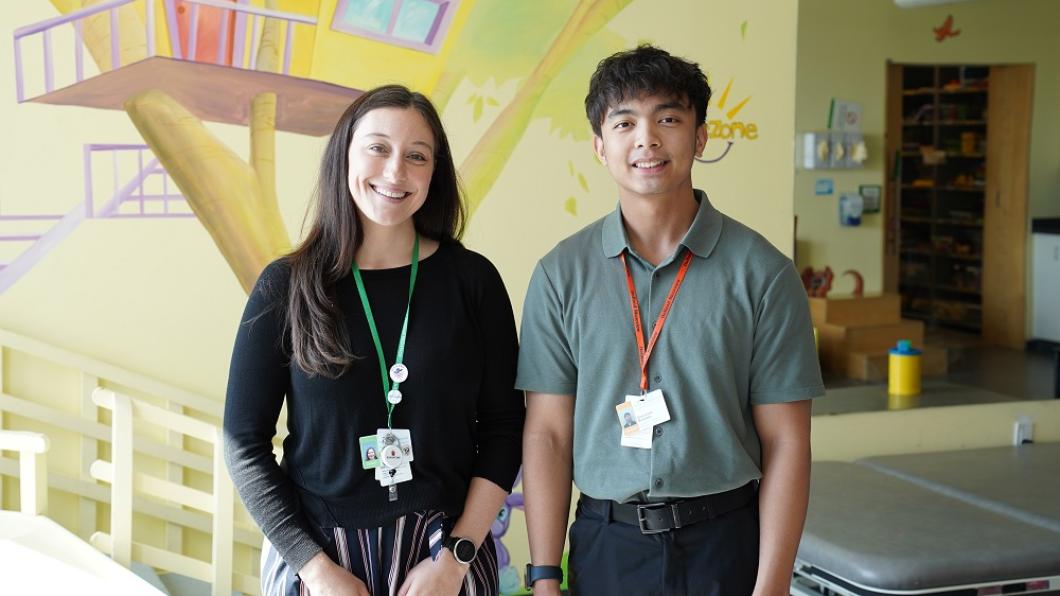
Occupational therapist, Madison Lazarou, views self-directed mobility as a human right and works with clients and families to assess what equipment can help children and youth access their environments, whether at home, in school or in their community.
Because spina bifida looks different for every child, care must be individualized. “The key is focusing on unique interests and goals that are meaningful for each individual child, youth and family member and how that might evolve over time,” she says.
This personalized approach can include the use of adaptive equipment such as wheelchairs, helping children and youth reach developmental milestones and navigate their surroundings with greater independence and confidence.
To support the next generation of leaders in pediatric disability care, Lazarou is mentoring Gian Carlo Balajadia, an occupational therapy student completing a field placement as part of his master’s program at the University of Toronto. The pair are part of Holland Bloorview’s interdisciplinary spina bifida and spinal cord injury team, which includes developmental pediatricians, nurse practitioners, occupational therapists, speech-language pathologists, social workers, physiotherapists, youth facilitators and life skills coaches. Together, they provide coordinated, family-centred care that supports each child’s unique journey.
Through his clinical placement, the University of Toronto graduate student is gaining firsthand experience adapting care to each client’s strengths and goals.
“I hope to further develop my clinical reasoning skills and my ability to provide care that helps clients feel heard and supported,” says Balajadia, who is completing his master’s degree in occupational therapy. “This experience has deepened my appreciation for the impact occupational therapists can have on a client’s quality of life.”
For Lazarou, the most rewarding part of her role is seeing that impact extend beyond the clinic.
“What brings me the most joy is when my clients come to me about how they were able to implement the skills they worked on in therapy into their everyday lives,” she says.
By Zoe Davidson
Photos by Brendan Byrne