
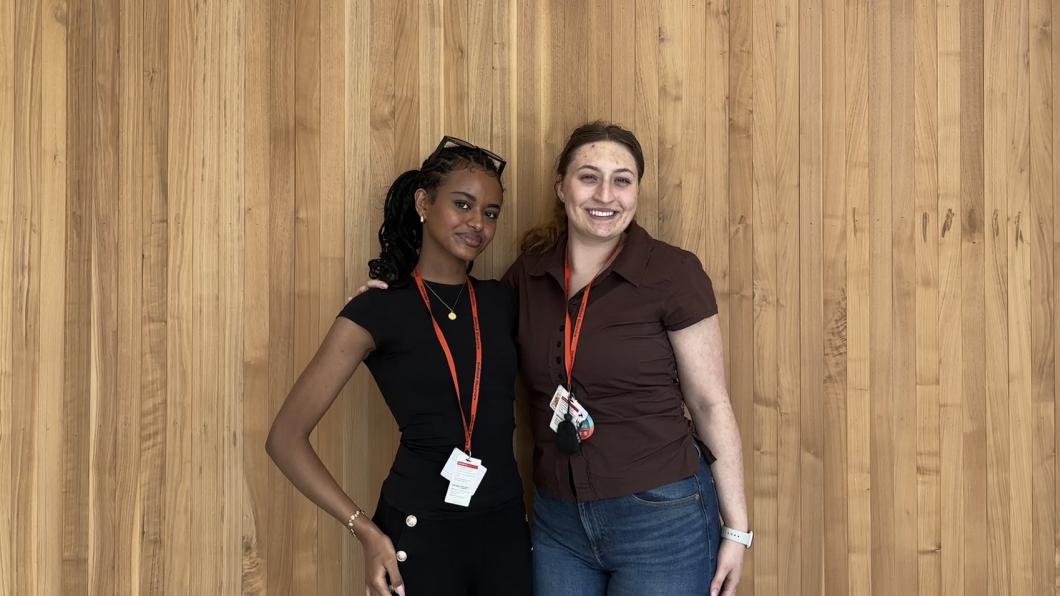
Q&A with Neve Van Daele, a summer student at the Bloorview Research Institute
Impactful research means listening to lived experience, not just observing it. For Neve Van Daele, a research student in the Ward Family Summer Student Research Program, this is more than a statement — it’s how she approaches her work every day.
The program is one of the only of its kind in Canada that gives undergraduate students interdisciplinary mentorship in childhood disability and developmental research.
Van Daele’s project groups depression-related symptoms together to reveal if they align with diagnoses of Autism Spectrum Disorder, Attention-Deficit/Hyperactivity Disorder, Intellectual Disabilities or not. While clinicians are trained to recognize “classic” symptoms of depression such as sadness or loss of interest, depression may look differently in someone with these conditions.
The Wilfrid Laurier University student is working with postdoctoral research fellow, Dr. Karisa Parkington, who shared on her experience working with Van Daele:

“She brings a natural scientific curiosity that is thoughtfully grounded in both lived experience as an autistic woman and a genuine engagement with the research literature. She is embracing a more advanced statistical approach to answer her research questions - you don’t commonly see that in undergraduate students without an engineering or statistics background.”
Read more on Van Daele’s research and experience in the program.
How did you become interested in research?
A major part of what drew me toward psychology, neuroscience and research was the experience of having clinicians and service providers take the time to explain the mechanisms to me when I had a concussion. Having a diagnosis helped organize my experience. I found it both validating and fascinating to understand how those mechanisms related to my actual lived experience.
I had a completely different experience when my autistic burnout was misdiagnosed with depression. While the two can look similar from the outside—low energy, withdrawal, difficulty concentrating—they feel different internally. Using the wrong label can lead to incorrect assumptions about what’s happening and result in supports that miss the mark or even make things worse.
I came to see the importance of listening to clients and participants, without those nuances, we may not even know what to investigate.
Why is it important for clients and families to be involved in the research process?
Including participant input throughout the process leads to more accurate, relevant and safer results. For example, autism research once focused on reducing “stimming.” Today, we understand stimming can support emotional regulation and removing it can be harmful.
How does the Sparking Student Opportunities for Advancing Inclusive Childhood Disability Research (SOAR) stream expand access to research opportunities for students?
The SOAR stream removes common barriers to participation. My application, for example, did not require a transcript - something that can disadvantage students who lack access to proper supports. By focusing on potential rather than grades alone, SOAR helps open doors for those who might otherwise be overlooked.
What has your experience in the program been so far?
I’ve had many opportunities so far to learn from scientists and test my ideas. We have weekly lunch-and-learns where experts present different areas of research, and all the students come together to share their work.
I’m also part of journal club, which you can think of like a book club but for articles in scientific journals - we discuss the findings and link them to our research.
The most meaningful part of my experience so far has been the generosity staff have shown me in terms of sharing their knowledge and experiences, encouraging me to participate in meetings and discussions and overall, welcoming me to the hospital and research labs.
How will the research you’re doing this summer impact clients and families at Holland Bloorview?
Understanding the different symptom profiles of depression may help clinicians, researchers, and families better recognize distress when it does not match the traditional presentation of depression modeled after the general population. Over time, this could contribute to more accurate assessment and more individualized care.
What do you want people to take away from your personal and research experience?
The same symptoms can have very different causes. Understanding mental health requires looking at biological, social and behavioural factors, and grounding that knowledge in lived experience.
Learn more about the Ward Family Summer Student Research program.
Story and photos by Zoe Davidson