


Second annual sector sustainability report card shows measurable gains
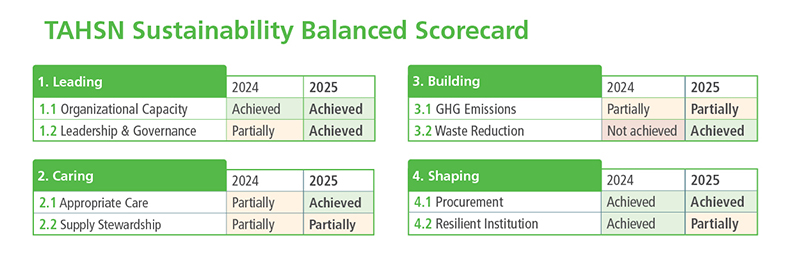
The Toronto Academic Health Science Network (TAHSN) has released its second Climate & Sustainability Report1, which highlights the efforts of 14 academic hospitals affiliated with the University of Toronto to prioritize and mobilize sustainability and climate action, as assessed by a collaborative Sustainability Balanced Scorecard.
Assessment scores across eight categories were collected last fall. Holland Bloorview strengthened its performance with 5 green (achieved) and 3 yellow (partially achieved). Last year, Holland Bloorview scored only 3 green with 4 yellow and one red (not achieved).
The report card release comes in advance of Earth Day 2026, taking place on April 22. Holland Bloorview regularly organizes a campus clean and a host of other activities to engage staff, clients and families in environmental sustainability.
“Our improved score reflects momentum and progress,” says Stewart Wong, vice president, communications, strategy and sustainability. “With a committed team and determined focus, we are making intentional choices to make Holland Bloorview operations more climate- and carbon-friendly.”
Highlights from Holland Bloorview’s 2025 sustainability journey include:
- the launch of its first-ever sustainability impact report
- winning a TAHSN award for implementing electrical energy-reduction measures
- supporting a cross-disciplinary Environmental Sustainability Task Force (ESTF) that is driving awareness and engagement initiatives across the hospital
- initiating plans to improve consumer waste sorting to increase landfill diversion rates
- donating, recycling and reusing furniture, diverting 24 tonnes of waste from landfill
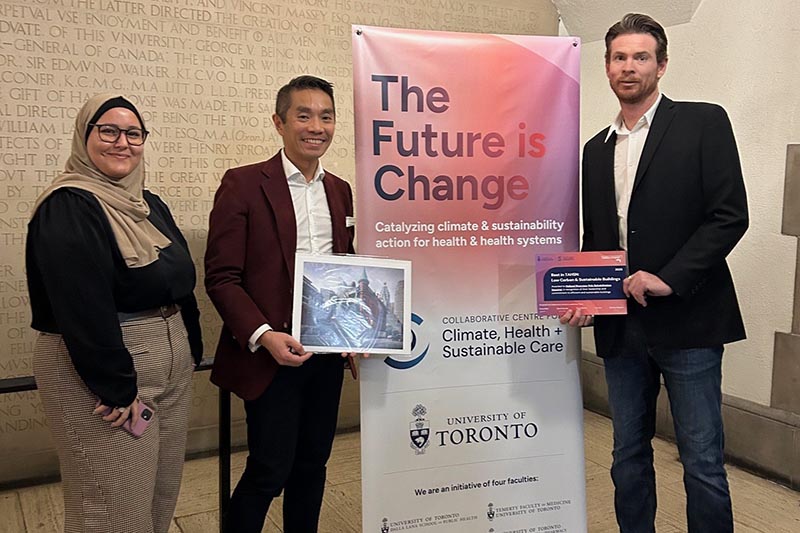
Last November, Holland Bloorview was awarded the Best in TAHSN: 2025 Climate & Health Award for Low Carbon & Sustainable Buildings.
Opportunities to improve include improved internal reporting on greenhouse gas emissions and integrating low carbon emission standards into the planning, design and construction of renovation projects.
“Seeing sustainability efforts measured, reported and improved upon year-over-year builds trust,” says volunteer family leader Kara Sharp, a member of Holland Bloorview’s Environmental Sustainability Task Force. “It shows that climate action here is thoughtful, accountable and deeply connected to care for children and families.”
System-wide progress
The new report demonstrates measurable system-wide progress across TAHSN to advance sustainability and climate action, with organizations increasingly embedding sustainability as a core value and priority and into governance.
In just one year, more hospitals formalized sustainability teams, embedded climate into strategic plans, strengthened emissions reporting, and expanded supply stewardship and appropriate care initiatives. The report reflects a shared commitment to continuous improvement and highlights areas of progress and innovation across the network, as well as opportunities to further advance this critical work.
TAHSN is one of the largest academic health science networks in North America, with more than 98,000 staff and serving more than 9 million patients each year2. With size, scale and breadth, TAHSN seeks to demonstrate local impact and global leadership in climate resilience, and environmental stewardship.
“Climate change is already affecting the health of our patients and communities,” says Sarah Downey, TAHSN chair and president & CEO, CAMH. “This report demonstrates how academic hospitals are taking concrete steps to reduce their environmental impact and strengthen resilience - while continuing to build momentum for further progress.”
About the annual scorecard
TAHSN’s Sustainability Balanced Scorecard evaluates leadership, clinical care, infrastructure and institutional resilience - reinforcing that environmental stewardship is inseparable from client care, quality and financial responsibility.
This scorecard was developed collaboratively, with the 14 TAHSN hospitals measuring themselves against four perspectives, each with their own foci:
- Leading: organizational capacity and leadership and governance
- Caring: appropriate care and supply stewardship
- Building: reductions in operational greenhouse gas (GHG) emissions and waste
- Shaping: procurement and resilience to climate shocks and stresses
The average score of participating hospitals was 4-5 green in 2025, in comparison to 3 green in 2024. No organization received the theoretical best score of 8.
The Sustainability Balanced Scorecard has been developed for the TAHSN Sustainable Health System Community of Practice (CoP). The CoP was established in 2020 by the Toronto Academic Health Science Network (TAHSN) and the University of Toronto’s Council of Health Sciences (CHS) to collaboratively address the challenge of climate change in the health sector.
The Collaborative Centre for Climate, Health & Sustainable Care is a multi-faculty academic unit at the University of Toronto, which serves as secretariat for the community of practice. Brittany Maguire, the managing director, and Fiona Miller, the director, led the development of the scorecard and report and have facilitated the CoP on various sustainability initiatives since 2020.
Another assessment is planned for 2026 to continue to monitor and drive performance, celebrate achievements and share practices and learnings across and beyond the network.
by William Lam
References
1Maguire, B, Nour, S, Miller, FA. Toronto Academic Health Science Network (TAHSN) 2025 Climate & Sustainability Report. Collaborative Centre for Climate, Health & Sustainable Care. University of Toronto, Toronto, Canada. January 2026.
2Toronto Academic Health Science Network (TAHSN). TAHSN Impact Report 2025. University of Toronto, Toronto, Canada. August 2025.