


Seeing your child in a hospital bed never becomes routine
By Robin Koczerginski
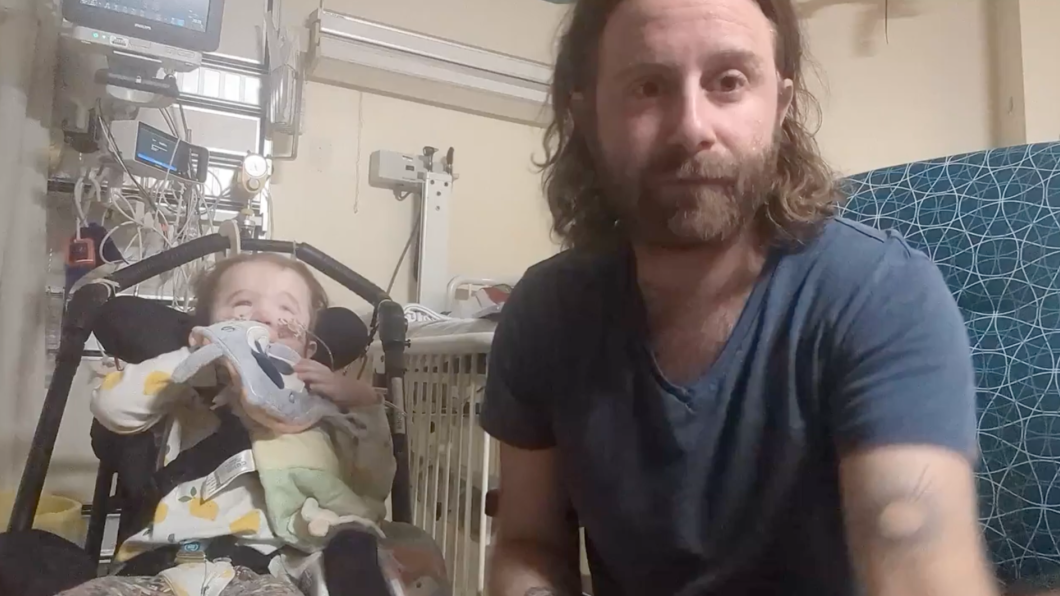
It’s 2024. This is the fourth admission for my daughter Bree at the Hospital for Sick Children in Toronto this year. Like always, we start the night with the long wait in the ER and are admitted to the 7th floor by morning.
The hospital bag is packed the same way every time now: phone charger, the long one that reaches the chair behind the bed, because if I’m holding Bree I need my wire to not tangle with hers; a dressy overshirt in case I have a remote work meeting; and a few toys because Bree will inevitably get bored.
I know the ins and outs of this hospital. During peak hours it takes four-and-a-half minutes from when I order my coffee on the Starbucks app to when it sits on the counter in the lobby. Running down to grab it and back up synchronizes perfectly with the time it takes a nurse to assess Bree's vitals. I know to ask for supplies I might need that night an hour before shift change at 7 p.m. I know the parking lot is almost full if we arrive after 8 in the morning, so I go straight to P4 for a spot.
When the nurse asks how I’m doing, I smile and say: "I'm good. I know the drill."
But don't assume my outward demeanour stems from an inner calm.
The first time your child is hospitalized, you’re raw, and it shows. You don't know the terminology, you stumble through the questions, and your voice cracks when you explain the situation to someone on the phone.
The world responds with compassion. There's a meal train; some flowers; the manager who says take whatever time you need and means it; and friends who text every morning. It's generous and real and helps to sustain parents.
After years of admissions, something shifts. What looked like an emergency can begin to look, from the outside, like a recurring appointment. I crack a joke with the resident. I make small talk while the nurse does a procedure. I text my boss a professional message about needing a few days, or how my schedule might be different this week, the kind of message that took me hours to compose the first time and now takes 30 seconds.
Understandably, when friends, family and co-workers hear we’re back in hospital, yet again, they tend to move on.
It's not that people care less. It is that human empathy is designed to surge in response to crisis, and crisis, by definition, is an unstable and dangerous event. When hospital stays become regular, emergencies appear to become more predictable, less cause for concern.
What people don’t understand is that a parent’s outward composure in hospital doesn’t mirror their inner world. Inside, it can feel like we’re riding a pendulum that swings from fear and helplessness to hope and relief and right back again.
My child’s wellbeing is still at risk. The monitors still beep at 3 a.m. I still sleep in a little “bed” next to the machines. My other kid is still at home without me, asking when I’m going to come back. The parking is still $25 a day.
The world outside the room keeps moving at a speed I no longer move at. The distance between those two speeds is just as wide on admission 15 as it was on admission one. Wider, maybe, because now I’m tired in a way I wasn’t the first time. But no one sees that. No one at the hospital is keeping track.
Why don’t I tell people? There are lots of complicated reasons.
Sometimes I feel like I am managing a PR campaign for my daughter, locked in a constant negotiation with how the wider world might perceive her, and the truth of who she is. I don’t want anyone to think she is a burden on us or the hospital because she needs to be seen more regularly.
To be honest, there isn’t much space in the hospital for a parent who falls apart in front of a doctor or nurse. We are expected to continue to show up, to continue to perform.
When it comes to friends or family, I feel a sense of guilt when people worry about me. And I don’t feel comfortable being the recipient of repeated generosity.
Maybe I also project a sense of calm in hospital for myself. Confidence can be a mask I put on to make the reality of our situation a little more bearable. Maybe hearing my own voice sound steady is the thing that keeps me steady.
If you’d like to help a family like ours, here is what I'd suggest.
Remember that what you see on the outside is a coping tool.
Ask yourself what you would do if a typical child were suddenly admitted to hospital. You'd probably text. You'd probably check in the next day, and the day after that. You'd treat it like the emergency it is.
You don’t have to do something extraordinary to convey support. The specific kindness matters less than the signal underneath it: “I know this is still hard.”
Remember that a seasoned parent’s ability to cope in hospital with a medically fragile child is real in the sense that it’s a practised skill. It’s not real in the sense that everything is fine.
Robin Koczerginski is the Community Programs Manager at AccessNow and the parent of two daughters, including Bree, who has Trisomy 13. He is currently writing a memoir about presence, loss, and the stories we tell about disability. Like this content? Sign up for our monthly BLOOM e-letter or take our short BLOOM survey.