

How the notion of a 'normal' body harms us all
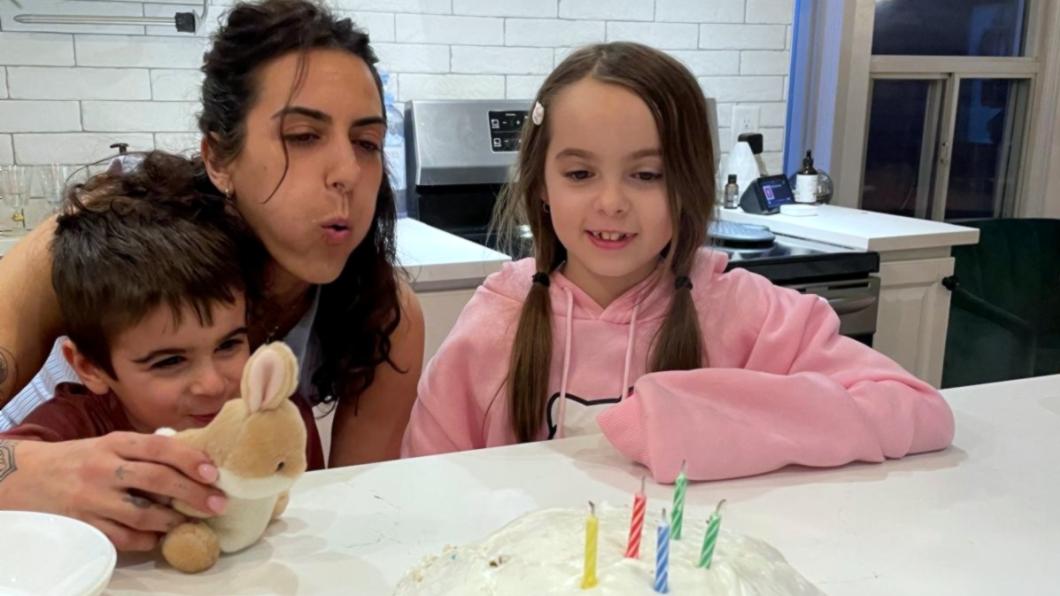
Charlie and Raewyn with their mother Donya Mosleh.
By Louise Kinross
Medicine classifies bodies as “normal” or “abnormal.” There is no grey area. Scientist Donya Mosleh, who completed her PhD in Rehab Science at the Bloorview Research Institute, is interested in how this binary creates assumptions about “what counts as a good life and who gets positioned as closer to or further from it.” In 2022 she published a paper that found the normal/abnormal binary pervasive in North American textbooks on children’s rehab. A major theme was the idea of abnormal children becoming normal. We spoke about her research and how disability became personal for her.
BLOOM: How did you get into disability studies?
Donya Mosleh: I was doing my undergrad in sociology, and I took a course in disability studies. I fell in love with the theory, the ideas, the way that it helped me reframe what it meant to be a human. I’m not sure why I took the course, as I didn’t have any significant or personal experience with disability.
BLOOM: I read your 2022 paper that looked at how the normal/abnormal binary underpins eight children’s rehab textbooks. You note that 'the texts construct disabled children as abnormal-becoming-normal.' Why is that problematic for disabled children?
Donya Mosleh: I think it’s a problem for everyone, not just disabled children. It’s extremely reductive to have a single idea of what constitutes the ideal, normal, desirable life, function or body.
All the textbooks claimed to take their understanding of disability from the International Classification of Functioning Health and Disability (ICF). The ICF did important work in expanding our attention beyond impairment alone to consider function and health in relation to personal and environmental factors. But it still operates within a biomedical logic where impairments are understood as deviations located within the body.
Rather than fundamentally rethinking disability, the ICF layers social and environmental considerations on to what is an individualized understanding of difference. It doesn’t move beyond the idea that disability originates within the body.
The more pressing question is how the body, the environment and social norms co-produce what we come to understand as disability.
In my research, and in my own life with my son Charlie, I see that what gets labelled as a difficulty or abnormality often shifts depending on the context. What is described as impaired in one setting may no longer be experienced as a problem in a setting where expectations or supports or the material environment change.
For example, Charlie has a sensory processing profile that requires constant physical engagement between him and his environment. He’s constantly moving, touching, squirming, rubbing his face and body all over everything to help him feel regulated.
In a school setting that’s interpreted as a deficit and problematic behaviour. And it can be disruptive to other children. It’s a problem in school because the expectation is that children should sit still and regulate themselves according to a specific understanding of the body. The idea of the normal body functions as a governing ideal that creates Charlie’s body, behaviours, and his identity as a problem that needs to be intervened on.
BLOOM: How is disability positioned in the textbooks you studied?
Donya Mosleh: They position impairment as an objective or statistical deviation from the biologically normal body. While the ICF does acknowledge social factors, environmental factors and even personal factors, it still maintains there is a normal biological body, which operates as a baseline upon which all other bodies are assessed and measured.
In conceptualizing impairment as an objective form of bodily deviance, it perpetuates the assumption that disability and impairment are naturally undesirable ways of being. These differences are seen as negative.
BLOOM: How does the concept of a normal body reflect cultural ideas about human worth?
Donya Mosleh: The normal biological body and its inherent capacities support a lot of our contemporary values. Progress is one of them. The normal body is constantly in development and always progressing in a linear fashion from one developmental stage to the other. As it develops, it increases its independence, its capacities become self governing and efficacious, and it becomes productive. It gets a job, engages in society and community matters, pays its bills and takes care of itself.
BLOOM: In your paper you write:
‘Within children’s rehab, neoliberal values are often reproduced in notions of individual responsibility for progress and well-being, and in the construction of outcomes oriented to independence, productivity and self-efficacy. The constructed normality to which disabled children are expected to aspire is that of an able-bodied, productive and self-sufficient adult citizen. In turn, disabled children, as deviant and abnormal, pose a direct threat to the assumption that neoliberal adulthood is universally desirable.’
You include an interesting case study from one of the books. A 10-year-old boy with autism is encouraged to film his classmates interacting, and then to watch the videos with his therapist to learn how he should socialize. How does that play into the theme of abnormal becoming normal?
Donya Mosleh: The therapist says: ‘I want you to video your typical peers.’ That distinction from the get-go creates this weighted difference between the child and everyone else. The problem is identified as an individualized problem. There’s this idea that there’s a normal way to be and a not normal way to be, and the boy is encouraged to make himself like his peers, to emulate them.
I would start out by asking what is the problem in this situation, where and how are these interactions taking place, and who is experiencing it? Has the child said: ‘I want to play with X, Y and Z, but I don’t know how?’
BLOOM: Or is the child happy doing their own thing? Or did some other student say: ‘That kid is weird and doesn’t know how to play with us.’
Donya Mosleh: Or did the early childhood educator, doing her job and measuring the boy against milestones that suggest by age 10 a child should independently initiate and sustain social interaction with same-aged peers, say there was a gap, and it must be filled?
BLOOM: Your paper suggests difference be seen as the default human condition in children’s rehab. You write: ‘Such an approach would circumvent the desire to homogenize difference in pursuit of an unspoken normative ideal and allow for disabled children to flourish in unique and meaningful ways.’
Donya Mosleh: Yes, the default should be we’re different and we need to continually challenge the way we create knowledge about the world. We might produce a collective ethos that difference is a good thing, it’s what makes us human and is what unites us.
The idea that difference is scary is so interesting to me. We are all averse to differences and find them unsettling and uncomfortable. The value of the kind of work I do with families is becoming comfortable with the uncomfortable. I don’t know the answers, but I can ask the question: How can we understand disability and childhood outside of development?
BLOOM: How did your doctoral research aim to find new ways of thinking about disability?
Donya Mosleh: For my thesis I worked with children diagnosed with Duchenne Muscular Dystrophy and their families. And it made me rethink time and the way we’ve valued time in contemporary society.
These children and families taught me to look at time differently. Their lifespans are shorter in comparison to the typical linear lifespan. But there are other ways in which time, and lifespan itself, can be understood.
One example was birthdays. You might assume a birthday celebration is a sad moment for families, because their child’s body is declining over time. But in these families, birthdays become moments of deep reflection. They pause, stand together, laugh, and share all the beautiful and hard memories they have lived. It was almost like they relived the moments together. Look at this life in the moment, in the here and now. Look at this life without a lifespan.
I asked the families to send me images, videos and text to learn about their current, everyday lifestyle. I wanted to know about the minute activities of their day-to-day routines.
When I went back to look at the data, there were hundreds of photos of previous experiences earlier in their childhood. I thought: ‘Why do they keep giving me stuff from way back when?’ Then I realized it’s part of their life, of how they see and experience their life to date. They aren’t necessarily oriented to the future.
They also submitted photos of themselves sleeping or napping. I thought: ‘How do I make sense of this?’ Then I saw these images as moments of resistance in a world where we’re always propelled forward and held accountable to a linear ideal of progress. It seemed these kids were saying something about [rejecting] this ideal.
BLOOM: What is most challenging about your research?
Donya Mosleh: I think one of the biggest challenges is finding ways to talk about these ideas in spaces that are often oriented toward quick answers and tangible outcomes. Medicine and rehabilitation are understandably focused on improving lives in practical, immediate ways, and that work is incredibly important.
My research, however, takes a slightly different approach. Rather than offering new interventions or solutions right away, it tries to slow things down and ask more foundational questions about how we understand bodies, disability, and development in the first place. That kind of work can feel less immediately actionable, but it’s important because those underlying assumptions shape the kinds of interventions we ultimately design.
This kind of inquiry also takes time. It often involves reflection, dialogue, and sometimes sitting with uncertainty rather than moving quickly toward solutions. In fast-paced healthcare environments, that can be challenging, especially when clinicians are already balancing so many competing demands.
So one of the biggest challenges is creating space for these conversations—not because people aren’t interested, but because the systems we work within tend to prioritize speed, efficiency, and measurable outcomes. My work asks us to pause, reflect, and sometimes rethink what we’re aiming for. That can be a slower and more collaborative process.
BLOOM: What’s most rewarding about your work?
Donya Mosleh: The conversations I have with people like you and other researchers and adults, children and families. I’ve learned so many things beyond research, academia and disability that have profoundly shaped my life. Going back to my study of kids with Duchenne Muscular Dystrophy, my perspective of time has shifted. I’m so much more relaxed about my own schedule. I’m way more gentle with myself around getting things done in certain time frames. I’ve been given permission to operate time differently by these families who understand and experience it in a unique way.
BLOOM: How did disability become personal for you?
Donya Mosleh: When my son Charlie was born, he was premature… Because I already worked in rehab and was doing work on development, I was very aware of developmental milestones. When Charlie started to not hit those milestones at a really early age, like six months, I realized there was something going on.
That’s when it became super personal for me. I did really struggle for a while on how to make sense of what was happening in my own life.
I had to draw on these developmental frameworks that I hated—that I was used to critiquing. And I felt, to some degree, was I an imposter?
Then I realized this could be an opportunity for me to explore how we could do things differently. That I could stop being so critical of these developmental tools without also acknowledging what they can do for us.
I needed the tools as a parent who was concerned about my child’s life. Not because he was deviating from some norm, but because the way my child experienced the world was distressing for him. He wasn’t enjoying the world and engaging with it.
I changed my approach to these tools. Instead of ‘Let’s critique it and rip it apart,’ I took from it what I needed to create the life I think my son needs, and I left behind what didn’t serve him. I had to individualize, or personalize, my approach to how I used these developmental tools.
I no longer reject or accept approaches or interventions at face value. I look at what Charlie is experiencing, and ask ‘What does he need right now?’ Not ‘What does Charlie need to be normal?’ But ‘What does Charlie need to flourish, here and now?’
BLOOM: Charlie is in school now. How do you talk to him about why he can’t move in certain ways there, without him interpreting that something is wrong with his body?
Donya Mosleh: The classroom is founded on the ideal of producing children who will become working individuals, so the normal body is seen as inherently desirable.
School environments tend to be organized around a specific idea of how children’s bodies should behave: sitting still, staying quiet, and controlling movement for long periods of time. These expectations aren’t neutral; they privilege certain bodies and ways of being over others.
My son’s body naturally wants to move, explore and physically engage with his environment. That’s how he focuses, regulates and learns. From my perspective there’s nothing inherently ‘wrong’ with that. In fact, many children need movement to think and participate meaningfully.
When I talk to Charlie, I try not to frame the issue as his body being the problem. Instead, I explain that different environments have different expectations for how bodies move.
For example: “Your body likes to move, and that helps you think and feel comfortable. Some bodies need more movement and some need less, and that’s okay. At school, though, there are rules about how bodies are expected to move, like sitting in your seat or keeping your hands to yourself.
Those rules aren’t because your body is wrong, they’re just how school is set up right now. We need to find ways your body can still move, but that work within those expectations.
BLOOM: What would be an example of something he can do while seated?
Donya Mosleh: One example we call monster hand smash (he loves monster trucks, so this is motivating). He sits in the chair and opens his knees about a foot apart. Holding his legs as firmly as possible, he then puts his hands into little fists and moves them back and forth between his legs as fast as he can. His legs do the resisting, and his arms are pushing and moving. But it isn’t very fast so it’s not disturbing to others around him. The muscle strain in his arms and legs really feels good for him.
What feels important to me is helping Charlie understand that the challenge isn't simply located in his body, it's in the relationship between his body and the environment. That shifts the conversation from 'fixing' the child to thinking about how environments can become more flexible and responsive to different ways of being.
Ultimately I want Charlie to learn how to navigate these expectations without feeling like he has to change who he is. And at the same time, I hope we continue to question why schools are structured in ways that make movement, something so fundamental to childhood, seem like a problem in the first place.
Donya Mosleh is doing a postdoctoral fellowship at Western University with scientist Gail Teachman, who is an adjunct scientist at the Bloorview Research Institute. The research looks at dominant ideas about children’s pain. Her PhD was supervised by Barbara Gibson, professor emerita at the University of Toronto. Like this content? Sign up for our monthly BLOOM e-letter or take our short BLOOM survey