


A couple's relationship can be frayed by a child's complex needs
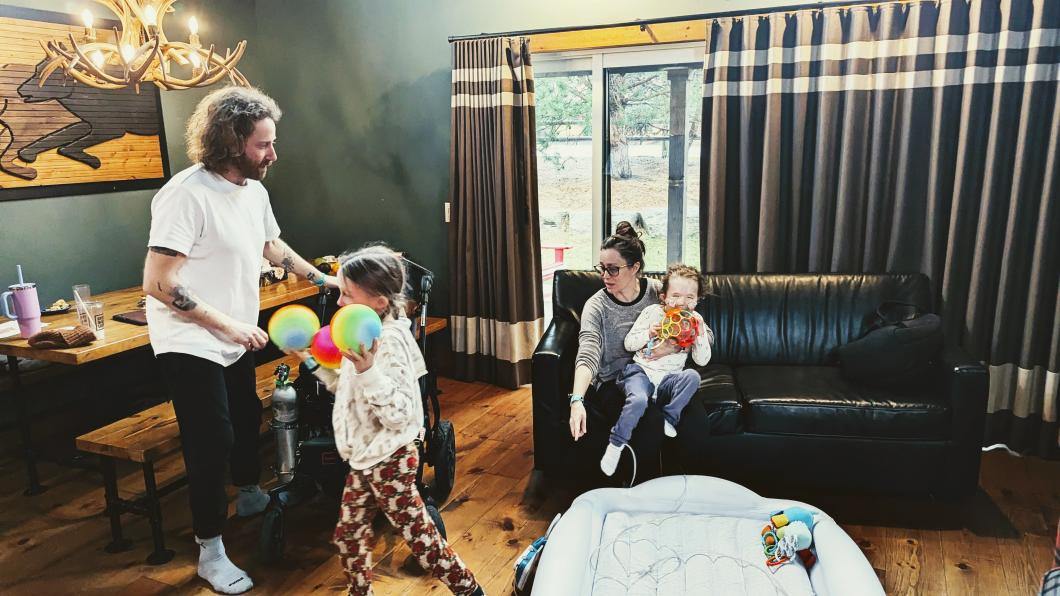
Robin Koczerginski (left) beside daughter Shyla (with balls) and partner Rachael and daughter Bree on couch. At Great Wolf Lodge
By Robin Koczerginski
This is what caregiving looks like in our household: Rachael is in our bedroom on the phone with a service coordinator, re-explaining our daughter Bree's medical history for what might be the fourth time this year. I'm in the kitchen making pasta and doing dishes. I have one ear on Bree's oxygen monitor, listening for any alarms while she sleeps, and the other on our older daughter Shyla, who needs help with an art craft she is working on.
We're one room apart, working completely different jobs for the same family. Some nights we won't talk to each other about anything other than logistics, and mostly over text while she is putting Shyla to sleep.
Bree has Trisomy 13. She was given a terminal prognosis before she was born. She's four now, and thriving in her own extraordinary way, but her care is constant and complex: G-tube feeds, a daily schedule of medications, oxygen support, nursing shifts, and an endless rotation of therapists, specialists, and system administrators who each need something from us.
Early on, Rachael and I thought the challenge would be medical. We didn't realize that later in her life, the challenge would be figuring out how to stay connected to each other while managing all of it.
We cope differently. Rachael is a processor. When Bree was in the NICU, Rachael researched, organized, and advocated. She fought doctors when the care plan didn't make sense. She learned the system and became fluent in it. When she's scared, she moves toward the problem.
I'm the opposite. When I'm scared, I go quiet. I retreat inward. During those early weeks and months, I withdrew into my phone, or silence, or a version of presence that looked like being there but wasn't fully. My nervous system sent me somewhere else. Not because I cared less. We struggled because of this disconnect.
We started working better as a team when we stopped trying to split everything equally and started paying attention to what each of us was actually good at. Rachael is better at the invisible labour, or the work no one sees. The insurance claims, the funding applications, the medication tracking, the emails to the nursing agency. This work is relentless and largely thankless and it runs in the background of every day.
I’ve learned to take on bigger portions of the visible labour. The long nights at the hospital when Bree is admitted. Making dinners, doing the dishes, and picking up Shyla from school, so she feels like a kid whose life isn't organized entirely around her sister's care. Staying up with Bree when the night nurse cancels. The hands-on, show-up-and-do-it work that I could pour myself into without having to navigate a system that my brain can’t organize as well as Rachael.
Naming this out loud changed things. Not because the division was perfectly fair. It definitely wasn’t and still isn’t. Rachael, like most medical moms I know, still does more. However, we learned to stop resenting each other for not doing the other person's job. Rachael stopped waiting for me to take over the funding applications. I stopped thinking the phone calls were somehow easier than the night shifts. We started seeing the full scope of what the other person carried.
But I also had to learn something harder. Dividing by strength doesn't mean you get to stay in your lane forever. There are weeks when the invisible labour buries Rachael. When three agencies need callbacks and the calendar is filling up with all the appointments and that tiny piece on Bree's suction machine or wheelchair breaks off again, and in those weeks I have to step in. Not to take over, because I'd do it worse and she knows it, but to take ownership of specific pieces. To say "I'll handle the nursing agency today" and mean it. That was a skill I had to build. It didn't come naturally.
Before Bree was born, Rachael and I might watch a movie in the evening, or connect more during dinner. Now most evenings are filled with tasks and checklists in our heads, or just exhaustion. That prevents organic moments of connection from popping up.
I want to be honest about what actually helped us, because I think the narrative around caregiving partnerships can lean too heavily on the couple, as though love and communication are enough to hold it all together. They're not.
The single biggest factor in our ability to function as partners has been the system of support around us.
For example, Rachael's mom Maria rearranged her entire life, moving from Ottawa to Toronto during the pandemic to live with us, and helps with Bree or Shyla on a daily basis. Maria knows how to care for Bree's medical needs, as does Rachael's sister Lauren. Our extended family helps a lot. There is also the private nursing support we are eligible for with Rachael’s employment, which lets us sleep and work and occasionally sit in the same room without one of us being on duty. There is also the fact that we both work from home which gives us a flexibility I don't take for granted. We’ve attended family camps and organization-led meetups where we connected with other medical parents, people who understood the specific texture of this life without us having to explain it. And these are just a few examples of the people who sustain us.
Our lives are threaded from supports that many families never get access to. When those supports are strong, Rachael and I are strong. When a nurse cancels or funding gets cut or a family member can't come, we absorb the cost, and it shows up in the space between us.
Communication helped too, but not in the way it sounds in a parenting article. It wasn't scheduled check-ins or learning each other's love languages. It was smaller than that. It was Rachael telling me, without accusation, that she needed me to see how many hours she spent on hold with the service coordinator. It was me telling her that the hospital nights were harder than I made them look. It was learning that recognition, just seeing what the other person does and saying so, goes further than fixing anything.
I don't want to give the impression we figured this out cleanly because we didn’t. There have been prolonged silences. Conversations that started about dishes and ended somewhere much darker. Moments where one of us looked at the other and thought: I'm doing this alone. If I’m honest, that last part was mostly Rachael looking at me. Those fractures are real and I don't think they go away entirely. They're part of the structure now. You learn to build around them rather than pretending they were never there.
We both work from home. Most days we pass each other in the hallway between tasks, trading updates about feeds and meds and school pickup times. It doesn't look like what I imagined partnership would look like before Bree was born. It looks like two people who kept recalibrating in order to survive extreme parenting demands. Who still sometimes get it wrong. Who learned that the best thing they could do for each other was build the system that holds them both up. And then, within that system, try to actually see each other.
Robin Koczerginski is the Community Programs Manager at AccessNow and the parent of two daughters, including Bree, who has Trisomy 13. He is currently writing a memoir about presence, loss, and the stories we tell about disability. Like this content? Sign up for our monthly BLOOM e-letter or take our short BLOOM survey