

The sisterhood in our house is built on differences
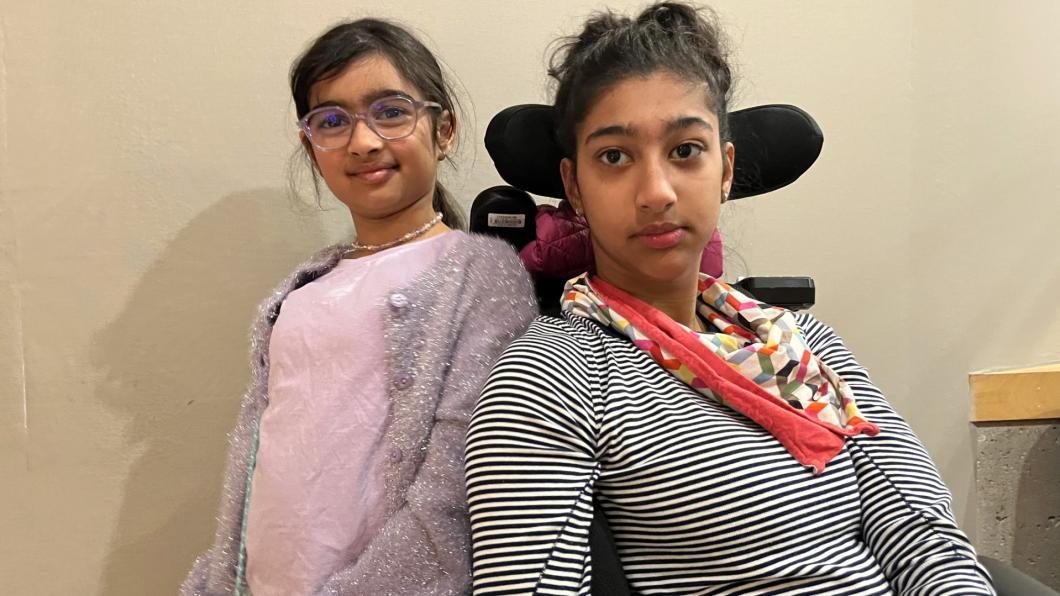
Nal, 8 (left), and Syona, 15
By Anchel Krishna
When I was pregnant with our second child, my daughter Syona was thrilled. There are seven years between the girls, and a full house was something we always wanted. It just took us a bit longer to get there, as we needed to adapt to Syona's cerebral palsy.
Syona loved to rub and kiss my growing belly, calling the baby “Booniya,” a name she made up that we used throughout the pregnancy. We did not know Booniya’s biological sex, so the whole thing was a game of surprise for us. Syona, though, was clear about what she wanted. She only wanted a sister and announced more than once that she would send the baby back if it turned out to be a boy.
Nal, a girl, arrived with some drama, as most babies do. Once we were all settled at home, watching Syona with her little sister became one of my greatest joys. She helped hold the bottle at feeds. She loved washing the baby bottles. And as Nal grew into a busy, mobile baby, I noticed she would seek Syona out in crowded spaces when she felt overwhelmed, like her big sister was a safe place to land.
If you had asked me then what sisterhood would look like in our home, I might have imagined matching outfits, whispered conversations and endless games, all adapted to meet Syona’s needs.
But like everything else in parenting, I have learned that what I imagine and what happens are often worlds apart.
My daughters are so different: in age, personality, interests and ability.
Syona loves loud music. The louder, the better. Nal prefers things quieter and often asks us to turn off the music or turn on a podcast.
Nal loves screens. Syona refuses to watch TV or movies. Nal wants to play with her sister constantly, while Syona often wants space. Nal hugs freely and with voracious affection, multiple times a day. Syona is more reserved and not especially interested in hugs.
In our house, sisterhood often means balancing competing priorities, while my husband Dilip and I quietly hope both girls do not have high-needs moments at the same time. There are also stretches of real conflict: for example, an early morning rally of shouts, yells and cries, all with a deadline of getting out the door.
One of the biggest things we try to do is make space for both girls to be fully themselves. When you parent a child with a disability, it is easy for the whole house to revolve around appointments, accessibility and accommodations. But we work hard to make sure Nal’s interests and needs matter just as much.
That means one-on-one time with each girl. Sometimes Nal and I plant flowers together or go on a trail hike. Sometimes Dilip takes Syona to the mall or the library, where she often makes new friends along the way. I never want Nal’s identity to become “the sibling of a disabled child.” She deserves room to figure out who she is. Even so, Nal is aware that she is the only kid in her circle with a sister whose disability looks like Syona’s.
Our goal as a family is to build a sense of belonging, leave room for each person to be themselves, and acknowledge that sometimes things are harder for us and we all need to flex around that. So how do we foster closeness between two kids who are so different? It comes down to encouraging shared and separate interests in roughly equal measure and letting the girls see what Dilip and I love too. Here are a few things that work for us:
- Treat them as a team. We try to do this in concrete ways. Pairing them up when we play a family game. Finding chores they can do together instead of separately. Talking up shared interests, like baking, which they both love helping with, or a good Thai meal, which they will happily eat their way through together. Even encouraging them to team up on Dilip and me to lobby for their favourite takeout.
- Stop jumping in. We let them answer each other’s questions and finish their own conversations, even when it would be faster to step in.
- Teach explicitly. We talk to Syona about what being an older sister means. We talk to Nal about Syona’s disability. And we connect both pieces back to what it looks like in their actual relationship.
- Make space for everyone. That means protecting each girl’s separate interests as carefully as the ones they share and letting Dilip and I have our own things in the mix too. In the car, that shows up as a blend of music and podcasts for the girls, with a smattering of '90s hits and hip hop to keep Dilip and me going. The girls roll their eyes. We keep playing it anyway. I want them to grow up knowing that the adults in their life are full people too, and that making room for everyone is what family looks like.
There are harder conversations too. Recently Syona told me that sometimes she feels left out because she is the only person in our family with a disability. Hearing that hurt, because we work so hard to build a home that feels inclusive and accepting. But it reminded me that disability can feel isolating, even inside a loving family. There are experiences she carries that the rest of us do not fully understand. So we sat with it, and we talked about it as a family.
I have also been thinking about how closeness does not grow from being alike. When I look at the family I was born into and the friends who have become family along the way, it is not our similarities that make us close. It is the act of doing life together, the ups and downs, which builds the bond.
Do we get it right all the time? Absolutely not. But we try, fail, reflect and check in before we keep going. My hope is that someday, down the line, the girls realize we were building something strong on the very foundation of their differences.
How do you build sibling relationships in your family? Comment below or shoot a message to BLOOM Editor Louise Kinross at lkinross@hollandbloorview.ca. We may share your ideas in future.Like this content? Sign up for our monthly BLOOM e-letter or take our short BLOOM survey.