

With a sledge, skates and friends we showed up to party
By Anchel Krishna
Winter in Canada has a way of making you brave.
A few years ago, we decided that we needed to get outside. Our hibernate-under-the-covers approach from November to March wasn't cutting it anymore. But when you have a wheelchair user in the family, like my daughter Syona, 15, winter challenges go beyond sub-zero temperatures.
Snow and slush don’t mix well with wheelchairs. Manual chairs are tough to push through the snow, and snow, ice and powerchairs are a bad combination. Getting out for a winter walk isn’t always possible.
Then we got a text from a friend asking how they could set up an ice-skating party so that Syona could participate.
I'm going to press pause on the power of this text. It wasn't about "Can Syona participate?" It was about how to organize this party so Syona would enjoy it.
Like most things in our life, advance planning, the right attitude and extra people power make things possible.
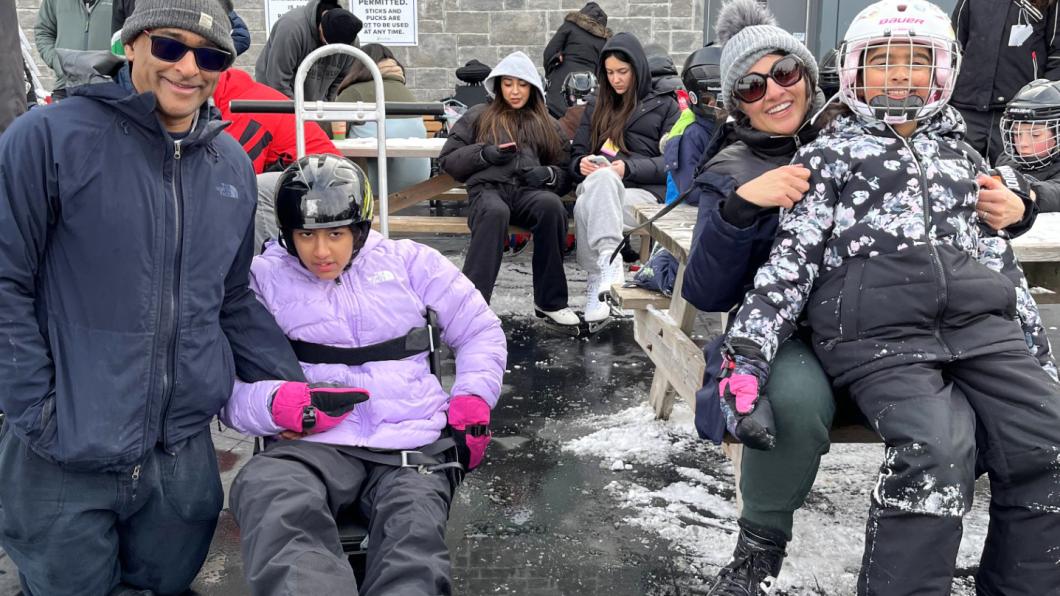
We borrowed a sledge through an equipment loan program at a community agency. A sledge is a piece of adapted equipment with a seat and two blades running along the bottom.
Sledge hockey is a spectacular event at the Milan Cortina Olympics. A sledge is also great for people who can't move on skates, allowing them to be pushed on the ice. We chose a rink that was barrier free and picked a time that worked best for most folks.
We arrived at the rink carrying what felt like our entire house: helmets, skates, all our winter gear, snacks, a sledge for Syona plus a healthy dose of my anxiety. The rink was alive with motion. Kids and adults zoomed by. Others who were unsteady wobbled along. We found our party crew and got Syona’s little sister, Nal, settled into her skates. We then transferred Syona from the wheelchair to the sledge, asking a friend to hold Syona and the sledge upright while we put on our skates.
Nal hadn’t skated in a year and was anxious. But as soon as she stepped on the ice, she charged off with her friends and didn’t miss a beat.
Syona was a little more uneasy. She asked some of our friends, who are very strong skaters, if they could zoom around with her. Dilip, my husband, stepped onto the ice and quickly found his rhythm.
Meanwhile, I had not been on skates in 10 years. Ten years, it turns out, is a very long time. The moment my blades touched the ice, I realized that balance was a concept I had taken for granted. My younger daughter skated by me, cheering me on. Then she told me I was telling the truth when I said I wasn’t good. She was right.
There is something deeply humbling about learning, or relearning, a skill in front of your children, especially when one of your kids has so many physical challenges. It is a moment that equalizes the playing field and helps them understand we are just human.
Friends rallied around me, slowing down, sharing tips, and encouraging me to keep going. A couple of hours later, I wouldn’t say I was gliding across the ice, but I could sort of move and felt a little more balanced.
As parents, we are usually the steady ones, the helpers, the guides. That day I was the beginner. It reminded me how much courage it takes to try something when success is not guaranteed.
What stood out about that simple winter afternoon was how naturally everyone helped. It started with the initial invitation and inclusive planning. At the rink, our friends gathered around without hesitation. Someone held the sledge steady. Someone else helped with the straps. Multiple people pushed Syona on the ice, allowing her to experience skating. The kids watched with curiosity and excitement. There was no awkwardness, no overthinking. Just people working together so we could all be part of the experience.
The day became a series of small victories for everyone, a shared adventure.
I learned that balance is something you keep practising, whether on ice or in life. Dilip was reminded of how the support of others can feel. Our younger daughter learned that fear softens when you face it. And our older daughter experienced the simple, powerful feeling of being included. She was not observing from the side. She was moving with us, laughing with us, sharing the experience. Our friends and their kids learned that with some planning and work, there is a way for everyone to participate, and they can play a role.
Parenting a disabled child often involves planning, advocating and navigating systems that aren't designed with your family in mind. That can feel heavy. But moments like this remind me that community changes everything. All the extra preparation and stuff can be worth it.
Who knows? Maybe next year we will tackle skiing.
Like this content? Sign up for our monthly BLOOM e-letter or watch our A Family Like Mine video series.