


Disability is a throughline in this student's work and family life
By Louise Kinross
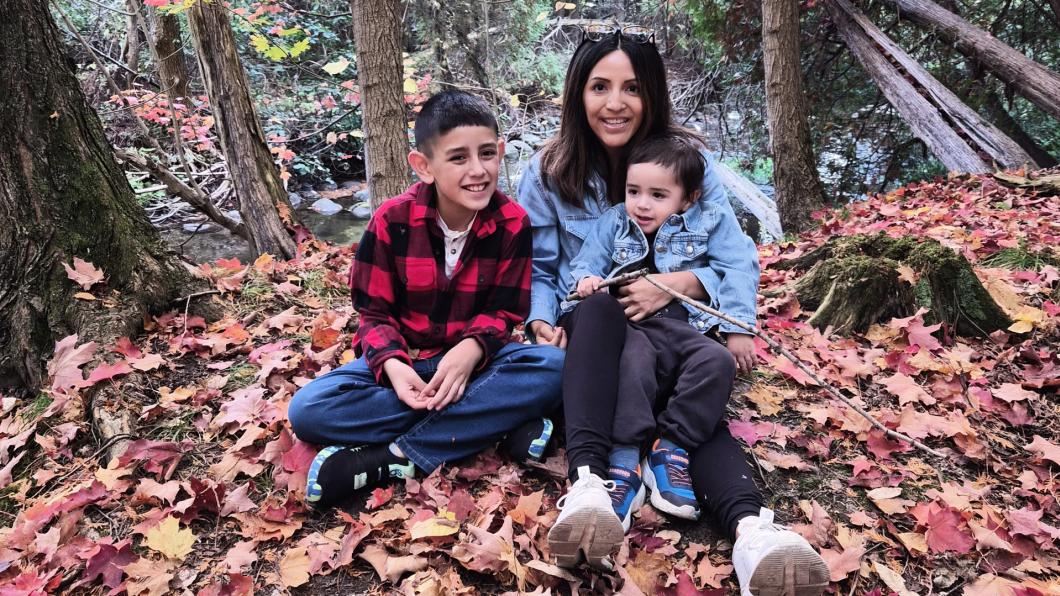
Maritza Basaran has so many touchpoints with disability. Her brother Jaimie is autistic, as are her boys Harrison, 10, and Louis, 2. More than a decade ago she worked as a research student and assistant at Holland Bloorview. She has participated in autism research here as a family leader, and today volunteers twice a week with inpatients in our school. She is also in her third year of social work at the University of Calgary, with hopes to work with disabled children and families in future. We spoke about how her experiences have shaped her.
BLOOM: In 2015 you were working as a research assistant here developing a video game that would make therapy fun. How did you get interested in that work?
Maritza Basaran: Video games were an important part of my brother Jaimie's life growing up. But he wasn't necessarily able to access them. He had to navigate systems that didn't always understand or support him well. That resonated with me, and I came to work as a Ward Summer Student in Elaine Biddis' Pearl Lab. The lab focused on cooperative play among siblings and families as a whole, with a game that would adapt to each of our abilities.
BLOOM: How have all of your experiences connected?
Maritza Basaran: Growing up I was a sibling. Now I'm a mom to two boys who have a diagnosis of autism. Navigating the system on behalf of my own children has brought me a new level of understanding. I see how advocacy plays a role on top of the emotional work, and it's often behind the scenes. It's not something that everyone sees.
BLOOM: It's often invisible to the outside world.
Maritza Basaran: Exactly. Another big area I got involved with was family engagement. When I was working in research I was listening to families and their stories made it clear to me that so many of the challenges families face aren't just clinical, but social and systemic. That's what drew me to focus more directly on relationships. Returning to social work felt like a natural next step to bring together my research, lived experience and the social justice piece.
BLOOM: How would you describe Harrison and Louis?
Maritza Basaran: Harrison is our kind, loving, very thoughtful little guy. This is feedback we get from every environment. He is a good friend. Louis is our high energy, silly, wild child. Louis encourages Harrison to do things that he might not do otherwise. Like running down the hill at the park with another group of kids. Because Louis is there, Harrison will do it and have a good time. At home, it's cool to see Harrison encourage Louis to calm down and cuddle, getting him a stuffed animal. They really balance each other out.
BLOOM: Did being a sibling influence the way you parent?
Maritza Basaran: Being a sibling to Jaime taught me early about patience and compassion, but also the importance of having someone who will always be there for you and understand you. I always wanted that for Harrison and Louis. I encourage them to support each other when they can, and give them space to develop their relationship the way they want.
BLOOM: You participated with Harrison in a research project to develop an online tool for families whose autistic children had feeding issues.
Maritza Basaran: Feeding for Harrison was a really big challenge. When we met with Dr. Sharon Smile and her team, the way they broke it all down and explained what was happening was so refreshing. We felt so heard, whereas in other settings people would give us advice that didn't work at home. For example, the school sent home a nutrition guide in Harrison's backpack, implying 'this mom doesn't know what nutrition is.'
BLOOM: So they misattributed his issues and blamed them on you.
Maritza Basaran: Yes. We have enough of that mom guilt, we don't need any more.
BLOOM: What was helpful about the approach here?
Maritza Basaran: We worked with a team that included a behaviour therapist, occupational therapist and speech-language pathologist. Just hearing that the problem wasn't caused by one thing was helpful, and taking a multi-disciplinary approach. Harrison's eating didn't suddenly improve, but we felt less anxious around meal time and I had more tools to respond to comments from the school system. I could point them to the feeding education hub at Holland Bloorview to learn more about challenges for kids with autism, and tell them we were part of this research study.
BLOOM: Why did you decide to go back to school to study social work?
Maritza Basaran: It goes back to my experiences with my brother and being a parent. I know how important it is for families to feel respected and understood and included as partners.
In the past I saw innovation tools and technology as being about access. Now I think of it as relational. I like creating environments where kids and families can feel safe to participate and feel heard. Through my research and family engagement I know that families and children have expertise. It's not just the science and academic side. I've found the most meaningful work around relationships: listening and supporting and walking alongside families, rather than always trying to fix things through intervention.
BLOOM: Does what you're learning in social work cross over into your parenting, or how you think about disability?
Maritza Basaran: Yes. I think it's that relationship building and understanding communities.
Our family feels 100 per cent supported by our therapeutic teams. They're wonderful. But day to day, I wish every family felt more a sense of belonging. It's only been in the past year that our family has found a real sense of belonging through other families who have children with autism. It's been a 10-year journey.
My understanding of inclusion has shifted. Before I thought it meant access. Now I think it's about are people feeling respected? Are their experiences valued? Are they able to feel a true sense of belonging within their families and communities? And holding the system accountable to do their part.
BLOOM: What kind of social work do you hope to practice?
Maritza Basaran: I'd like to support families at the intersection of research, social work practice and advocacy. I'm interested in building bridges between families, clinicians and researchers, as I am a person who touches all of those realms. I'd like to build services that are shaped with families, rather than the top-down approach we often see. The families I talk to everyday have so many ideas of what they want to see more of in the community. But they don't know who to tell, and no one is really asking them either.
I'd like to contribute to a system where disabled people and their families don't have to work so hard to be heard, where their knowledge is recognized as expertise.
I also want to explore disability not in isolation, but in intersection with race, culture, income and gender status, and how those shape families' experiences.
BLOOM: You volunteer two afternoons a week with inpatients in our school. What are you learning there?
Maritza Basaran: I'm learning a different side of disability. Instead of developmental disability, I'm learning about children who acquire disability through trauma or illness. I'm learning a lot about resilience. I see their growth from when they first come to school and when they're discharged. It's amazing.
It's a reminder that everyone has their own journey, and you can learn from everyone's story and lived experience.
I also see how many people touch one client's life, from the nurses and doctors and therapists to the school team.
BLOOM: If you could change one thing about how the system supports autistic children in Ontario, what would it be?
Maritza Basaran: It would be creating a needs-based system, but in order to make it truly needs based, we would need to remove age cut-offs, because needs are always evolving. Also, the system really needs to see clients and families as experts.
I think we've seen inclusion of families at times, but it's still very controlled. And so much trust with families has been broken by the government.
Like this content? Sign up for our monthly BLOOM e-letter or watch our A Family Like Mine video series.