
Using imaging to understand autism
Autism Spectrum Disorder (ASD) may be the fastest-growing developmental disability in the world, but it remains persistently difficult to diagnose, manage or treat, since it presents different symptoms and outcomes in different children, so there’s no way to predict which potential intervention might work for which child.
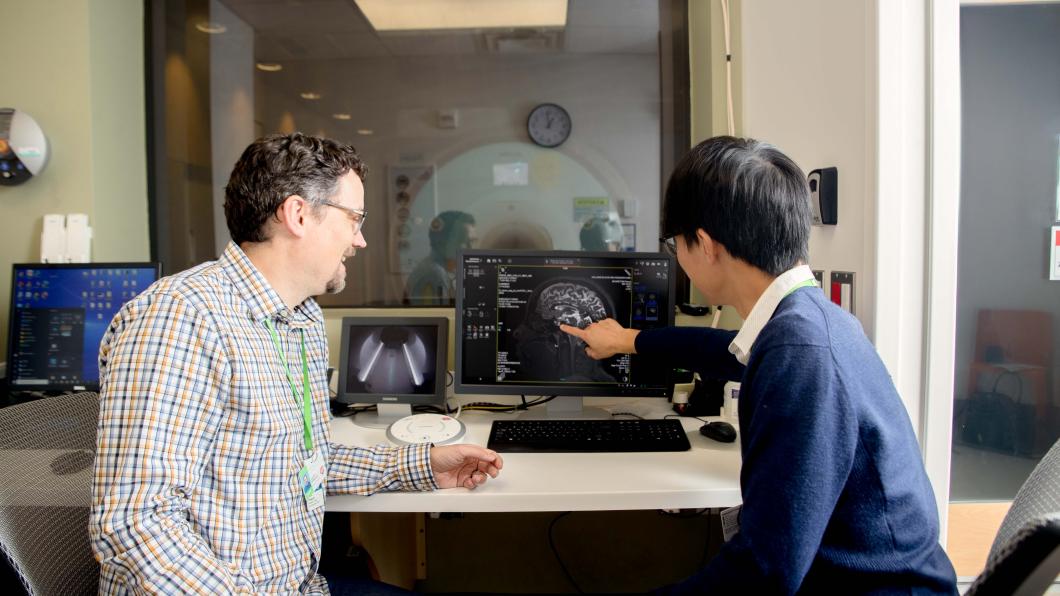
Bloorview Research Institute neuroscientist Dr. Jacob Ellegood is working to change that, thanks to a gift from a longtime donor, the Lillian Meighen and Don Wright Foundation. Dr. Ellegood’s research involves using Holland Bloorview’s child-friendly MRI to scan and study the brains of children and youth with ASD and other neurodevelopmental disorders in order to understand their biology and ultimately develop personalized care tailored to each child.
For years Dr. Ellegood has been using mouse models to investigate biological and behavioural issues associated with ASD. His current research work involves combining data from these models with data derived from scans of Holland Bloorview clients with neurodevelopmental disorders.
“Rather than focusing on symptoms, the idea is to look at the actual biology and see if we can cluster the mouse and human models based on their brain similarities and how they overlap,” Dr. Ellegood explains. “We could get a more precise read on what might be going on in the human brain, and that would allow us to subcategorize neurodevelopmental disorders like autism into more precise boxes and lead to better interventions. The goal is to take this group of kids and put them into the right category that gets them the right treatment at the right time. That’s what precision medicine is.”
Dr. Ellegood is also advancing equity in research by using AI to help capture data from kids who have difficulty being scanned in the MRI—data that researchers have previously not been able to include in studies. “It’s about making the MRI more inclusive,” he says. “There are kids with profound autism who can’t sit still or who feel uncomfortable in the scanner, and if we can include their data, it’s going to be better for the whole field of research.”
The Lillian Meighen and Don Wright Foundation’s donation has allowed Dr. Ellegood to hire two student researchers and a full-time research engineer to help with these projects, and it will also enable him to scan more clients in the MRI, publish more research papers, collaborate with his BRI colleagues and apply for larger grants to fund and expand this ground-breaking work.
“This support allows me to think of the big ideas and write the grants, and importantly, it gives me the time to do all that,” he says. “It also allows me to bring in people who can help and contribute.”
The gift is part of our $100 million campaign to establish the Centre for Excellence in Childhood Disability at Holland Bloorview and translate our research innovations into clinical care more quickly to help more kids and families. Ultimately, Dr. Ellegood’s work could lead to the development of personalized interventions for kids with ASD and other neurodevelopmental disorders.
“Dr. Ellegood’s work has real potential to increase our understanding of autism by looking at the way human brains are similar and different, and designing treatments based on those similarities and differences,” says Priscilla Wright, daughter of the late Lillian Meighen and Don Wright and chair of their family foundation. “We are happy to support this remarkable research, and very excited to watch it develop.”