
Turning research into everyday care across Holland Bloorview
One year after receiving Innovation for System Partnerships, Implementation and Evaluation (INSPIRE) Awards, two Holland Bloorview projects are demonstrating how implementation funding can transform promising ideas into meaningful improvements in care. Today, both innovations have become embedded in clinical practice and continue to improve care across the hospital.
From delivering more personalized prosthetic care to strengthening support for children and youth returning to school after acquired brain injury, the projects are already making a measurable difference for clients, families and clinicians. Together, they highlight how implementation-focused innovation can support Holland Bloorview's priorities around personalized care and a learning health system by ensuring research and innovation translate into everyday practice.
Supported by the Holland Bloorview Kids Rehabilitation Hospital Foundation, the INSPIRE Awards provide internal funding to help teams implement, evaluate and sustain home-grown innovations that improve care across the hospital.
Establishing an in-house fabrication solution for personalized prosthetic covers
For people who use lower-limb prostheses, cosmetic covers can be about much more than appearance. They can improve confidence, support self-expression and help individuals feel more comfortable in everyday life.
Until recently, producing customized prosthetic covers often relied on external manufacturers, resulting in longer turnaround times, higher costs and fewer opportunities to refine designs based on client and clinician feedback. This INSPIRE-funded project set out to establish an in-house solution that would make personalized prosthetic covers more efficient, accessible and responsive to individual needs.
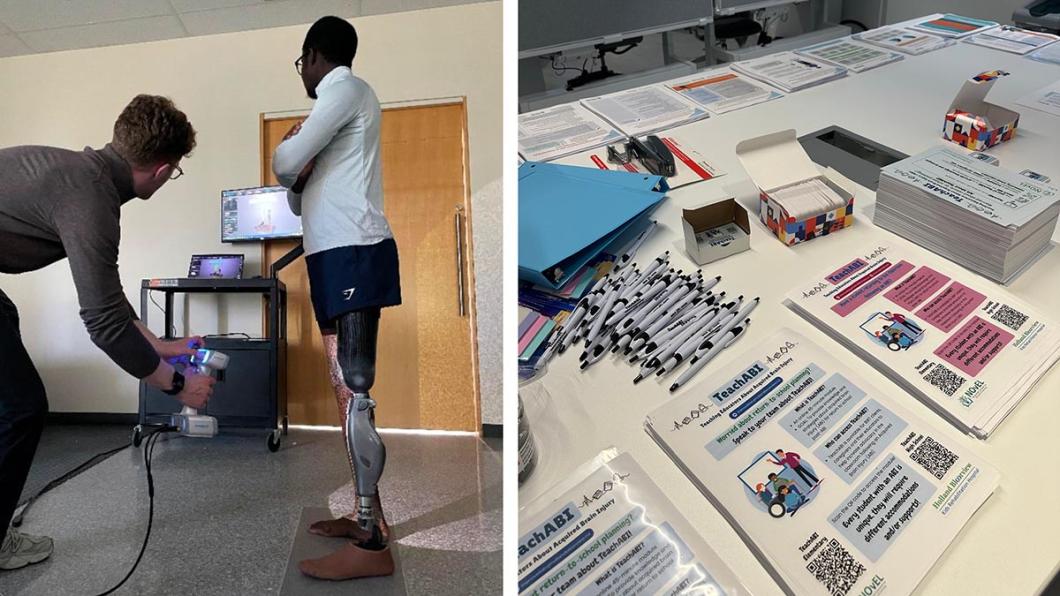
Led by Dr. Jan Andrysek and Zinnia Batliwalla, the team developed an in-house digital workflow for designing and fabricating personalized prosthetic covers. The project team also included Calvin Ngan, Elaine Lorette, Samuel Barsky and Sheila Kellner. Using digital scans of a client's limbs, they created custom covers tailored to each person's anatomy and preferences while reducing reliance on external manufacturers.
The impact has already been significant. Compared with outsourced production, the new workflow reduced turnaround times by 47 per cent and lowered average costs by 33 per cent. During the project, the team successfully designed and produced customized prosthetic covers for five clients while working alongside four clinicians to refine the process before integrating it into routine clinical practice. The workflow is now positioned to continue as part of routine care, ensuring future clients can benefit from faster, more personalized prosthetic solutions.
Continuous feedback from clients and clinicians informed every stage of development, leading to lighter designs, improved aesthetics and magnetic closures that made the covers easier to use. For participants, the impact extended well beyond the technology itself. One client shared that the new cover meant they could “wear my shorts again,” while another described it as “so cool” - small but meaningful reminders of how personalized solutions can improve confidence and quality of life.
 “One of the most rewarding aspects of this project has been seeing how personalized design can make a meaningful difference for clients. This project demonstrates what can be achieved when clients, clinicians, technicians and researchers work closely together. Every piece of feedback helped us refine the workflow, resulting in prosthetic covers that are not only more efficient to produce but also better reflect each individual's needs, preferences and identity,” said Dr. Jan Andrysek, senior scientist at the Bloorview Research Institute.
While the prosthetic covers project focused on personalized technology, another INSPIRE-funded project focused on ensuring evidence reaches children, families and clinicians when they need it most.
Implementing TeachABI at Holland Bloorview: Advancing Back to School Transitions for Young People with Brain Injury
Returning to school after an acquired brain injury can be challenging for children and youth, their families and the educators supporting them. TeachABI is an evidence-informed educational resource designed to help improve understanding of acquired brain injury and provide practical strategies to support successful school reintegration.
Led by Dr. Shannon Scratch, Andrea Hickling, Christine Muscat and Alexa Irvin, the TeachABI implementation project integrated an evidence-informed educational resource into the Brain Injury Rehabilitation Team's discharge planning process to better support children and youth returning to school after acquired brain injury.
Rather than creating new educational resources, the team focused on how to embed TeachABI into routine clinical practice. Working closely with clinicians, caregivers, educators, youth and school transition liaisons, they examined existing workflows and identified the most effective ways to introduce the resource throughout the care journey. Through interviews, focus groups, co-design activities and ongoing evaluation, they developed practical implementation tools that fit naturally into clinical practice.
Today, 31 clinicians and school transition liaisons have incorporated TeachABI into their practice and the resource has been accessed by over 80 users, including clinicians, caregivers, educators and students. The implementation will continue beyond the INSPIRE funding period as a sustainable part of routine discharge planning within Holland Bloorview's Brain Injury Rehabilitation Team, helping ensure children and youth continue to receive consistent support as they transition back to school.
 “Returning to school after a brain injury involves many people - from clinicians and families to educators and school staff. By embedding TeachABI into our care pathways, we're helping ensure everyone has access to consistent, evidence informed resources that can better support children and youth throughout that transition,” said Dr. Shannon Scratch, clinical neuropsychologist and senior clinician scientist at the Bloorview Research Institute.
Learning from implementation
Although the two projects addressed different clinical priorities, they share a common outcome: both have successfully translated innovation into sustainable clinical practice. Rather than ending when the funding period concluded, both initiatives continue to be used at Holland Bloorview, ensuring their benefits extend well beyond the original grant.
By evaluating outcomes, learning from clinicians, clients and families and continuously refining how care is delivered, both projects support Holland Bloorview's vision of a learning health system - one where research, innovation and real-world experience work together to improve care over time. Together, they demonstrate how implementation funding can bridge the gap between research and practice, ensuring innovative ideas become lasting improvements in care for children, youth and families.
As these projects continue to improve care across Holland Bloorview, a new cohort of INSPIRE-funded teams is building on this momentum. Meet the 2026-27 INSPIRE Award recipients and learn about the innovative projects that will shape the next generation of care. Read the announcement here.
We would like to thank the Holland Bloorview Foundation and the generosity of our donors who made this possible.
By Priyanka Shah