Scientist amplifies autistic voices, joy and art
By Louise Kinross
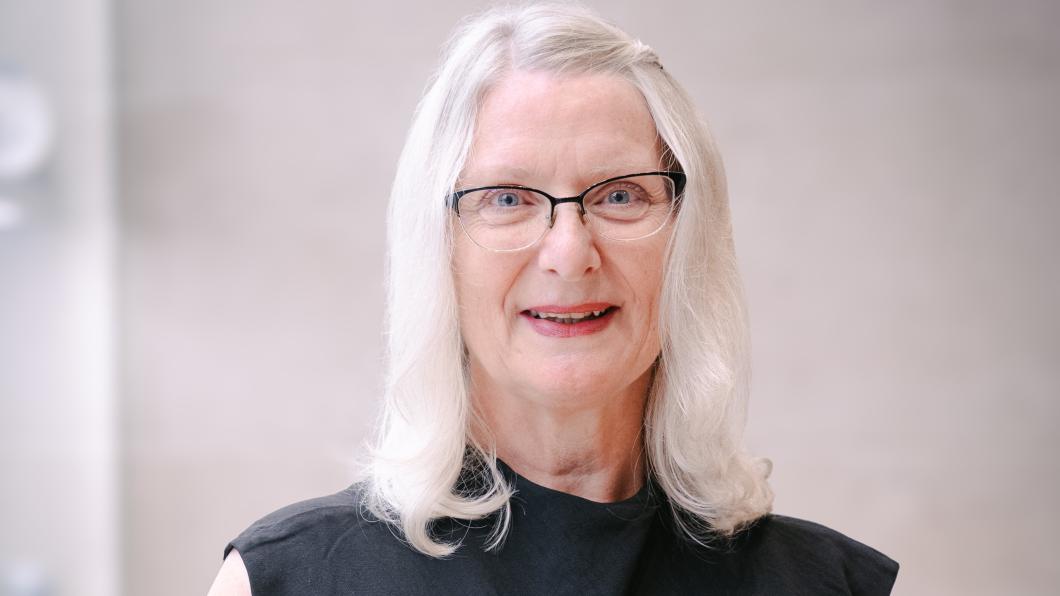
Dr. Patricia Douglas (above) received a 2026 EKO award for leadership for her Re•Storying Autism project. It brings together neurodivergent people, families, clinicians, educators and artists to make stories about autism that celebrate difference and reject the idea that autism is a problem to solve. Over 150 stories have been collected. Douglas identifies as neurodivergent and has two neurodivergent sons, one of whom is autistic. She was a special-education teacher and is an associate professor in disability studies at Queen’s University in Kingston, Ont.
BLOOM: I was struck by your quote about wanting to ‘intervene into systems that exclude and do violence to difference.’ Can you explain and elaborate on that?
Patricia Douglas: It’s a provocative quote, right?
That desire I had to intervene in systems came from things that I observed when I was a teacher in school systems: Things like restraints being done on six-, seven- or eight-year-old kids. Police being called and small kids escorted out in handcuffs.
Sometimes it went the other way, when kids became very upset and chairs were thrown. Clearly things were not working in the way that we hoped for kids or teachers, and families were also stressed.
Rather than locating the problem within the individual child or the individual teacher or the individual parent, in doing the research that I did, I came to understand the ways in which systems are setting us all up.
At the time I was doing research on education and I was a teacher. Education systems were made with the expectation that every child is that mythical, ‘normal’ student who can be productive, who can sit quietly, and who can do all the things the normative student is supposed to do.
I also saw the incredible efforts of teachers and kids and families to do their best, despite resource constraints and other approaches that don’t work for these kids. The quote comes from when I was trying to understand what was not working.
Over time, I came to understand that there are intersections with other kinds of differences, in addition to autism and disability: Kids who are also working class or they're racialized or they're gendered.
It's a complicated history. It's nobody's fault, but it's certainly our responsibility to try to make changes at a systemic level. Everyone on the ground is working so hard and we're kind of bumping up against systems that are not built for flexibility or for affirming different pathways through the school system or social care and social services.
BLOOM: Would that quote apply to healthcare?
Patricia Douglas: In some ways, I think it does. But healthcare has a different purpose and comes with a different history.
I think healthcare is great if you have an acute issue that you're presenting with, whether that’s a wart on my toe or something severe like cancer.
But things like autism and neurodivergence get grouped into a kind of pathology paradigm, as Robert Chapman would call it, or a deficit paradigm, where that can only take us so far. It doesn't give us a lot of information about how we can live our best lives.
So yes, I think it's a different history of trying to fix and cure and ameliorate and remedy, which we want and need for some things, but I don't think we need for others.
There are all these people on the ground that are trying to do affirming and inclusive approaches. But we're still caught by these systems that were built up around ideas and ideologies that aren’t open to different pathways for living our best lives.
BLOOM: Would you say that a lot of those ideas come from capitalism and what a productive citizen is supposed to look like?
Patricia Douglas: Absolutely. I think our systems are infused with them. I would even go so far as to call it racial capitalism. That's a term that Leanne Simpson and others use to indicate, again, that there are intersecting social identities and experiences and community locations.
We need workers to do X, Y, Z, and the value of a different pathway and life becomes something that is often treated with suspicion within capitalist systems, even though we have the inclusion movement and all sorts of amazing practitioners.
If you think about the welfare systems and social service systems, they barely give a living amount of money, do they? If you can't be 100% productive and 100% non-disabled, then there's this other pathway that is very, very difficult and comes with all sorts of negative attributions.
BLOOM: How did you get into your field?
Patricia Douglas: I was a teacher working in special education. I'm also neurodivergent, with an invisible disability.
I had my own experience masking and performing in a normative way so I could work full-time and care for my kids. It wasn’t easy but I found ways to manage.
Then I had two sons with different kinds of neurodivergence. My older son attracted the label of autism.
I encountered a dissonance between life at home and the systems outside it.
At home, we could take our time and celebrate the wonderful person and child he was and is. It was full of love and affirmation. But when we encountered systems, none of it worked. The way he needed to take care of himself, along with his talents and skills, clashed with those systems, and it really woke me up. It made me want to make bigger changes within the systems.
Twenty-five years later, I have more questions than answers. But my work really came out of wearing multiple hats: a person with a disability, a mom of two sons who learn differently, and a teacher in a system that I could see wasn't working for anybody.
BLOOM: For your older son, there was this distinction between how he was able to be at home and then how he was not able to be at school?
Patricia Douglas: Yes, so school was always a challenge. We were in the mainstream kindergarten and Grades 1 and 2. But, you know, even in kindergarten, there were questions and looks and all sorts of things that happened. Parents who thought my child shouldn't be in school.
In Grade 3 he went to a self-contained classroom which was a gifted, behaviour and autism class. It was very small, but it didn’t go well because when you have kids who are all similarly struggling, they don’t have a lot to anchor themselves.
So I ended up taking him out of school for the rest of the year and homeschooling him. Then I homeschooled the next year, half time. After that he went into different configurations of classes with kids with behaviour labels, then he was in a gifted program for a few years and that went okay. But he never finished high school.
BLOOM: What does he enjoy today?
Patricia Douglas: He loves cooking. He loves playing Minecraft and creating all these incredible worlds within Minecraft. He's really good at managing things. So he managed a Starbucks for a little while, but it became quite intense.
He loves music, he loves playing guitar. He likes to travel, so he joined me in London for a little while in between my various research projects going on in Europe, so that was fun. He loves to go for walks and knows probably every single street in Toronto. He loves to find out about things. He’s quite a researcher. He cares about the environment very deeply.
BLOOM: Would you say that he's happy in his life?
Patricia Douglas: I think that he is looking for what his best life is. He moved out two doors away from me which is great because we can go back and forth.
He’s in a band with some other folks. He’s exploring working part-time at something a little bit less stressful and maybe taking some courses to bridge to university.
BLOOM: When you did your PhD, how did you find autism framed in medicine?
Patricia Douglas: Generally, as a problem that needed to be solved. That was in 2007, 2008. I found a lot of medical research, genetic research and cognitive psychology.
I found very little about what things can help you live your best life. I don't think that autism is a problem to solve or something to cure. So that's sort of my position.
I also found a lot about Applied Behavioural Analysis (ABA) at the time that was very deficit driven. Lots of language of pathology and disorder. That's all medical language, isn't it?
What was missing was the person. There was lots of medical language talking about autism as if it was some kind of object. And it didn't ever talk about the person. It talked a bit about families coping and stress in families. It didn’t talk about love or joy in families.
And it didn't talk about what autistic people thought, wanted, needed or desired—in their own words. So that was a big gap in the research.
There was very little about Black or Indigenous autistic students' experiences in education or healthcare. Racialized experiences were missing. Girls and women were missing. So that's sort of where I began.
I also found a lot of divides between different fields. So, healthcare didn't really talk to education, didn't really talk to family studies, didn't really talk to disability studies. I was interested in bringing those people and stories and perspectives together because I think a plurality of perspectives is needed.
BLOOM: How did you want to change the story of autism?
Patricia Douglas: I wanted to elevate the stories of autistic people and those who work with and love them. I put autistic people, families and clinicians in the same room.
Often there are differences of opinion or tensions across those experiences.
But when you use storytelling people start to listen to each other and understand and appreciate where the other person is coming from.
Because we all want the same thing. We want the best thing for our young people. We want the best thing for our families.
But we’re navigating systems that began in a different era that looked at autism as a problem we had to eliminate or solve or cure or make better or remedy.
BLOOM: Do you include intellectual disability as a type of neurodivergence?
Patricia Douglas: I do, yes.
BLOOM: I’ve read children’s books about neurodivergence where they talk about autism, ADHD, and dyslexia, but they appear to purposefully leave out intellectual disability. What formats did you use for the storytelling?
Patricia Douglas: In the first five or six years I did only digital storytelling. Some of the workshops were in person and during COVID, some were online. I worked with the Re•Vision Centre for Art and Social Justice at the University of Guelph. Storytellers would come in with a story idea and leave, three days later, with their video finished.
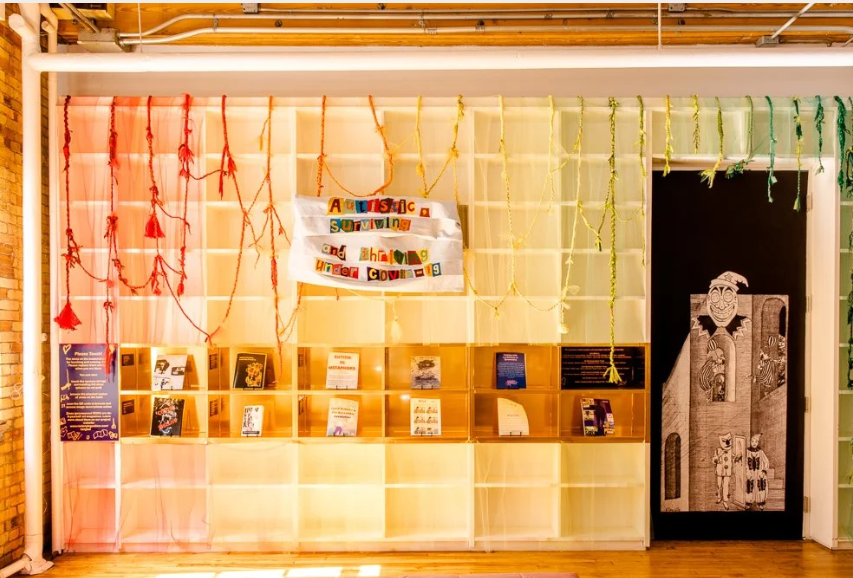
Since then I’ve done digital zines. We worked with an art educator to print them and exhibit them at Tangled Arts, which was really fun (see photo below). Those were about surviving and thriving under COVID. Now I’m also doing photography and storytelling with PhotoVoice.
It’s a method we’ve been doing up North in Ontario with Algoma Family Services and Batchewana First Nation.
That's been on Autistic Youth Thriving. Youth from age 12 to 25 have told us what they need to live their best lives and thrive.
Then we're co-designing services with our partners that align with what youth have told us that they need in Northern communities.
We also did a project called Tired of Spinning Plates in England with adult caregivers of adults with intellectual disabilities. We’re trying to bring it to Canada now.
So Re•Storying is now an umbrella for all these projects that I lead and take part in.
BLOOM: What has been most challenging about this work?
Patricia Douglas: One is that it's quite intensive. I hold a lot of stories at this point, some of them full of beauty and hope and others that are quite painful to hear and to hold. There have been times where I’ve had to really make sure to care for myself.
BLOOM: How do you manage the heaviness?
Patricia Douglas: There are a few things. I'm much better with my boundaries than I used to be. I try to have bounded work hours because this kind of work can grow and take over. When I’m not working, I’m not looking at stories. You need to make sure you have a full life and a very supportive team. We debrief and we have ways to kind of take a break if one of us is struggling.
I think also spacing it out. There was one day I did six interviews all back-to-back. And I had to stop the car on the way home and cry. Not because it's sad necessarily, but just because it's a lot to hold, right? It's a lot to hold when you hear the same story over and over and over again.
It’s about the fact that our systems are not built to work for everyone. And that holds true whether I’m in Belgium or Switzerland or England or Aotearoa New Zealand. Now I’m part of a project called Global South Connect where I’ll be doing work in India. Capitalism and colonization are also part of India's history. So, though they have very different contexts, the stories have similarities because we're dealing with systems that were not built for us.
BLOOM: Is there one country you’ve been to that seems to be a model for improving systems?
Patricia Douglas: I find small initiatives the most hopeful. I have an initiative called NeuroVibes that accidentally turned into a large annual event in Kingston, because I work at Queen's. The idea was to bring together neurodivergent students, families, service providers, and educators. We thought we'd get 30 people and we got 200.
This year rather than an evening event it’s become a two-day event. Young people will tell their stories. We also have a variety of research and practice-oriented panels, neurodivergent performers, food trucks, up to 20 community organization displays, and fidget toys and art that young people make.
The other locations I find hopeful are working alongside Indigenous communities. As I have come to understand, in many Indigenous languages there isn't a word for disability or for defect. I can't speak for my Indigenous partners, but I understand there is a belief that all of us, in our uniqueness, bring strengths or gifts which are needed for the community to thrive. It’s very relationally oriented, rather than focused on an individual fitting in, being productive and learning in one way. Nicole Ineese-Nash, who I collaborate with, writes about this.
BLOOM: What are the greatest joys of your research?
Patricia Douglas: I think relationships, and being trusted to hold stories.
I think working alongside different communities and the relationships that emerge and the surprising ways in which people who take part in story work and research go on to use it to launch into different activities for themselves.
BLOOM: Do we need to drop the deficit approach from how we understand disability as a whole?
Patricia Douglas: Yes. That doesn't mean that medicine or therapies aren't necessary or needed or wanted. I do think that we need a sea change.
Sometimes when I'm talking about the work I do, I'll use the DSM-5 criteria for autism spectrum disorder as an example. The first two words are ‘persistent deficits.’
I think you're defining a person. It does something to the people who that label gets applied to. It can be both great for helping you to understand yourself, but it tends to also…
BLOOM: Close all the doors.
Patricia Douglas: Yes.
BLOOM: It reminds me of when my son was in an elementary school and they had an MH class, which stood for ‘multiple handicapped.’ One day a student was touring parents around the school and she said: ‘This is the MH class.’ The parents said: ‘What is MH?” And the girl froze. She didn’t want to say ‘multiple handicapped.’ Even a child could see how stigmatizing it was.
Patricia Douglas: Sometimes I think diagnostic criteria are helpful. But there's one scholar I work with, his name is Nick Hodge, and he talks about schools without labels. He says maybe we need these right now in our systems in order to navigate.
But after we understand that this is a label that this child has been given, we should tuck it away in a drawer and close the drawer and be with the whole child. The label doesn't really help us that much when we're living at home, teaching in a classroom or even providing a service. It doesn't tell us that much.
BLOOM: You talk about decolonizing your research. What does that mean?
Patricia Douglas: I’ve started to think about it as an anti-colonial approach. It’s being in relationship with Indigenous communities in many different locations.
The Western approach to research gives you a particular understanding of the individual and of learning. So decolonizing means unlearning some of the assumptions I come in with and holding space for Indigenous leadership.
It means partnering in ways that funding and other resources can benefit my partners rather than just going in and taking and leaving with stories. It takes relational work and those relationships are sustained.
Like this content? Sign up for our monthly BLOOM e-letter.