

Before I met my daughter Bree, I googled her
By Robin Koczerginski
The night we received our daughter's genetic diagnosis prenatally, I did what any parent would do in the 2020s. I opened my laptop and started searching.
Diagnosis Wikipedia page. Life expectancy. Prognosis. Survival rates.
The internet soon became a kind of phantom limb, something I could feel even when I wasn't using it. A tingling promise that answers existed somewhere, that someone had already asked my question and someone else had already answered it. All I had to do was scroll long enough to find the thread, the forum, the desperate 2 a.m. post from some parent who had walked this road before me and left behind a trail of digital breadcrumbs.
Receiving a scary diagnosis about your child is drastically different today than before the invention of the internet. And the experience is remarkably different from even 10 years ago, as we've graduated from the passive entries of Wikipedia and WebMD to the immersive, uncurated chaos of the modern feed.
The problem, I would learn, is that while the internet is a warehouse of information and opinion, it cannot tell you what to do. And it certainly cannot tell you who your child will be.
I want to be fair to the internet, because it gave us real things.
It gave us a crucial Facebook group for families with children who had Trisomy 13 like my daughter. Parents and caregivers who understood without explanation, didn't flinch at medical terminology, and always had posts waiting for you to read. It gave us resources, lived experiences, and questions to ask our medical team. It connected us with organizations across borders. There were YouTube videos of real families showing their day-to-day experience that humanized the statistics and medical jargon. That mattered. We also had trusted information at our fingertips of peer reviewed studies that we could reference in conversations about our daughter’s care.
But the internet also did something else. Before I ever held my daughter, before I knew the weight of her in my arms or the sound of her breathing, the internet told me a narrative of who she was. And it got the story wrong.
Here is what I learned first about my daughter: a life expectancy. A statistic. Because I learned her diagnosis before I learned her face, because I learned what could go wrong before I learned what she might love, because the internet introduced me to my daughter as a collection of deficits, a series of risks, a prognosis measured in days, I started thinking of her as a “disability” instead of a person.
Then there was the discourse.
I found forum threads where strangers debated whether parents like us were selfish or brave, whether continuing a pregnancy like ours was an act of love or cruelty. People who had never met our family, who knew nothing about our daughter except her chromosome count, rendered verdicts in comment sections. Some were vicious. Some were sympathetic in ways that felt almost worse. Pity dressed up as support.
Those voices stayed with me. They lived in my head through my daughter’s birth, into the first NICU nights, during hard appointments, and moments that should have belonged only to a father and his child.
And then there was the comparison trap: other families in the same groups, navigating similar diagnoses. I watched their milestones and their losses. I read their eulogies and judged how they told their stories, then felt shame for judging. I scrolled through Instagram and Facebook and saw typical families with typical babies. Healthy children, held by parents who were planning futures. I felt the distance between the feed an algorithm was showing me and my reality like a physical ache.
Beyond information and diagnosis, our access to the endless digital world did something else to me in those early days. It offered escape. The phone was easier than presence. The search bar had become a place to disappear when the room felt like too much. I don't think I'm alone in this. The internet gives us an exit when we need one. But sometimes we take the exit when what we really need is to stay.
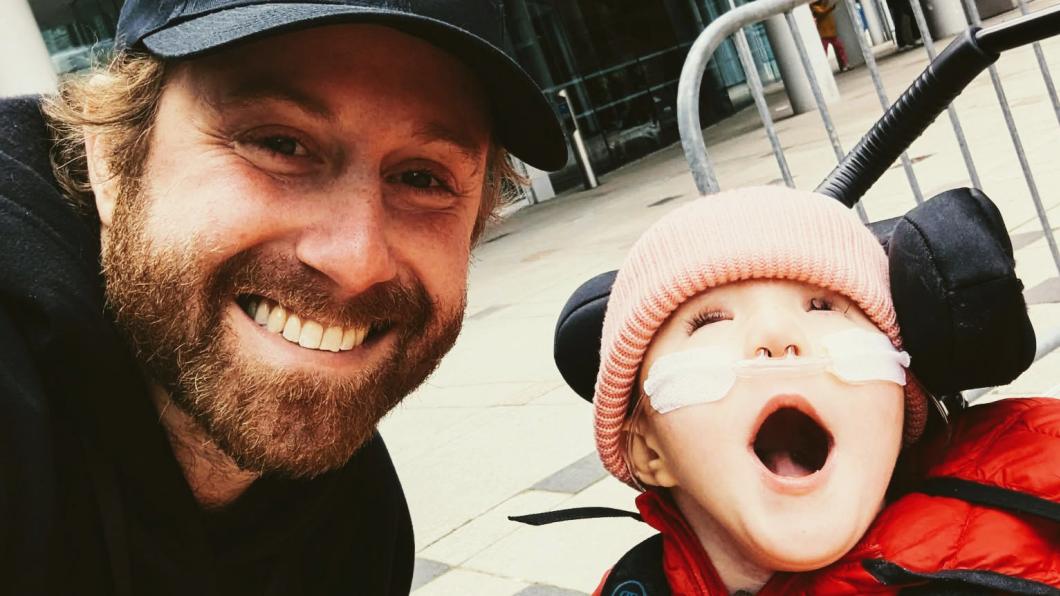
My daughter Bree is almost five years old now.
She does not match the Google results. She doesn't match the medical textbook descriptions or the statistics I memorized in those early weeks. She matches herself.
She is physically and developmentally disabled. And she is, without exaggeration, the happiest person I have ever met. She tracks her sister's voice across a room and kicks her legs so hard the bed frame shakes. Her joy doesn't compute against the medical prognosis I built up in my head. It exceeds every container I tried to put her in.
The internet told me the wrong story about my daughter. Not wrong medically, but wrong philosophically. Wrong about what a life requires to count. Wrong about what's possible when you stop measuring a person against a diagnosis and start seeing them as themselves.
I still use the internet. I still find community, resources, and connection there. But I've learned to hold it differently now. It's a tool, not an oracle. A place to find information, not necessarily truth.
If you're early in this journey, scrolling through search results in the middle of the night, looking for the post that will tell you what to do, I don't have that post. No one does. But I can tell you this: the child in front of you will not be the child the internet described. They'll be someone the algorithm could never predict.
Robin Koczerginski is the Community Programs Manager at AccessNow and the parent of two daughters, including Bree, who has Trisomy 13. He is currently writing a memoir about presence, loss, and the stories we tell about disability. Like this content? Sign up for our monthly BLOOM e-letter or watch our A Family Like Mine video series.