

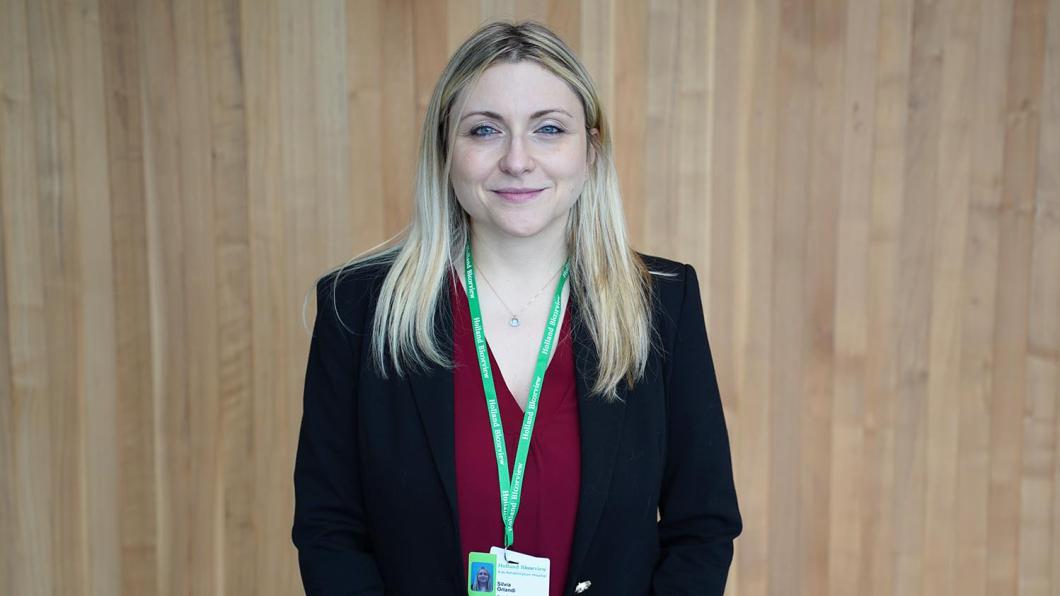
New scientist advances personalized neurotechnology for children and youth
Imagine being able to use signals from your brain to interact with a computer, navigate a virtual environment or control a mobility device.
For children and youth with neuromotor disabilities who may have limited ways to move, communicate or interact with their environment, brain-computer interfaces could open new possibilities for independence, participation and rehabilitation.
It’s a field Silvia Orlandi has spent years researching and developing - and one she is now returning to the Bloorview Research Institute (BRI) to help advance. Orlandi, who joined BRI as a scientist on Oct. 1, brings expertise in pediatric brain-computer interfaces (BCIs) and rehabilitation engineering that will expand the institute’s existing work in this area.
Orlandi’s research focuses on developing and translating personalized BCIs - systems that use brain activity to interact with technology - to support communication, mobility, participation and motor and cognitive rehabilitation for children and youth with neuromotor disabilities.
Her interest in developing technologies for children began early in her engineering studies in Italy. During her first university internship in the neonatal intensive care unit at Meyer Children’s Hospital in Florence, Orlandi worked with a baby who had been born weighing just 650 grams. Her research examined whether infant cries, together with physiological signals such as cerebral oxygenation, could offer insights into the neurological and physiological status of vulnerable newborns.
“That experience really shaped me,” says Orlandi. “It was my first exposure to the idea that different signals - voice, physiology, movement and eventually brain activity - could be brought together to understand something that a child might not otherwise be able to communicate.”
Designing technology around the child
While BCI technology is advancing, much of the field has focused on adults, with adult-centred approaches often adapted for children. Orlandi’s research aims to address that gap by developing pediatric-specific, personalized approaches that account for the developing brain and children’s individual motor, cognitive and communication profiles.
“What excites me most about pediatric BCI research is the possibility of creating an additional pathway for a child to interact with the world when movement or speech is limited,” says Orlandi.
“The most exciting question is not simply whether we can decode a child’s brain activity, but how we can translate that activity into something meaningful for that particular child.”
Her work brings together neuroscience, biomedical engineering and clinical practice. She plans to develop non-invasive BCIs while exploring the future potential and feasibility of implantable BCI technologies for pediatric populations. Her research will also investigate how BCIs can be integrated with technologies such as virtual reality, powered wheelchairs, robotics and mobile applications to enhance independence, participation and personalized rehabilitation for children and youth with disabilities.
Children, families and clinicians will be involved throughout the development process. For Orlandi, their involvement is essential to understanding not only how technology should be designed, but whether it addresses something meaningful in a child’s life.
“Children and families bring expertise that we don’t have as researchers: they know their own lives, priorities and challenges,” says Orlandi. “Involving them from the beginning can help us decide not only how to build a technology, but also what is worth building in the first place.”
Her long-term vision is what she describes as “precision pediatric neurotechnology”: rather than asking a child to adapt to a predefined BCI, developing a BCI that adapts to the child.
From postdoctoral fellow to scientist
Orlandi’s new role marks a return to a research community she knows well.
She began her academic career in Italy, earning a bachelor’s degree in electronics engineering and a master’s degree in biomedical engineering from the University of Firenze. She later completed a PhD in bioengineering at the University of Bologna.
In 2016, her research journey brought her to Canada and BRI, where she spent five years as a postdoctoral fellow in the PRISM Lab. Her work included developing personalized assistive technologies for children with cerebral palsy and complex communication needs, as well as research involving speech recognition, video analysis, BCIs and the application of machine learning and deep learning to brain and physiological signals.
One experience from those years has stayed with her. Orlandi worked on personalized speech-recognition technology that enabled a child with severe motor and communication disabilities to independently write an email to his father for the first time.
“I still remember the child’s smile as he thanked me, and his father’s tears of joy,” says Orlandi. “For me, technology is never the final goal. The goal is what that technology can make possible for a child - being able to express themselves, interact with the people they love and gain greater independence.”
After completing her postdoctoral fellowship in 2021, Orlandi returned to Italy, where she established herself as an independent researcher. She became a junior assistant professor at the University of Bologna and led the Rehabilitation Bioengineering Laboratory at the Institute of Neurological Sciences of Bologna. There, she led research integrating pediatric BCIs with virtual reality and powered mobility for children with neuromotor disabilities while building collaborations between engineers and clinical teams.
“Returning to Holland Bloorview as a scientist feels very special to me, both professionally and personally,” says Orlandi. “I am returning to a place that helped shape me as a researcher, but this time I am coming back with my own research vision and the opportunity to build something new.”
For Dr. Tom Chau, distinguished senior scientist and lead of the PRISM Lab, Orlandi’s return represents an exciting next chapter.
“It’s exciting to see Silvia return to BRI as an independent scientist and establish a research program of her own. During her time in the PRISM Lab, she deftly led many rehabilitation engineering research projects from babies to young adults, with partners from multiple institutions. Her commitment to make a meaningful difference in the lives of children with disabilities is second to none. I look forward to seeing her innovations in pediatric BCI and beyond!
Building the PANDA Lab
At BRI, Orlandi is establishing the PANDA Lab - Personalized Adaptive Neurotechnology Development for Assistive BCI - dedicated to developing personalized and adaptive brain-computer interfaces.
The lab will work in close collaboration with Holland Bloorview’s Clinical BCI Program, bringing together neuroscience, engineering and clinical practice to help translate emerging technologies into clinical applications.
When choosing a name for her new lab, Orlandi wanted something familiar, easy to remember and accessible to children, while also being recognizable across different languages and cultures. PANDA immediately felt right, she says.
“My hope is that PANDA becomes a place where we start not from a device or an algorithm, but from the child - their abilities, needs and goals,” says Orlandi. “I would like families to come to us with a need rather than having to fit into a technology we have already developed.”
Ultimately, Orlandi hopes PANDA can help move pediatric BCI from something children primarily experience through research studies toward technology that, when appropriate, can become part of their everyday lives.
“We’re delighted to welcome Silvia back to BRI and to see her begin this next chapter here as a scientist,” says Dr. Evdokia Anagnostou, vice president of research and director of BRI.
“Silvia brings a unique combination of expertise in brain-computer interfaces, artificial intelligence and rehabilitation engineering that will strengthen our capacity in pediatric neurotechnology. Her focus on developing technologies around the abilities, needs and goals of individual children aligns strongly with our strategic focus on precision health and personalized solutions. We’re excited to see Silvia build her research program at BRI and translate advances in neurotechnology into new possibilities for children and youth with disabilities and developmental differences.”
Beyond the lab
Outside of research, Orlandi stays busy with her twin boys and has long had a passion for fitness. She previously worked as a fitness instructor, teaching Pilates, indoor cycling, kickboxing, and other classes. She also enjoys meditation, jazz and bossa nova, cooking for friends and family, reading, travelling and discovering new places and cultures.
Orlandi also has a passion for languages. She speaks Italian, English and French and a little bit of Arabic, Spanish and Portuguese. She says connecting with people from different cultures is one of the things she appreciates about living and working in an international environment like Toronto.
By Priyanka Shah
