


Imagination, flexibility and fun fuel this therapy team
By Louise Kinross
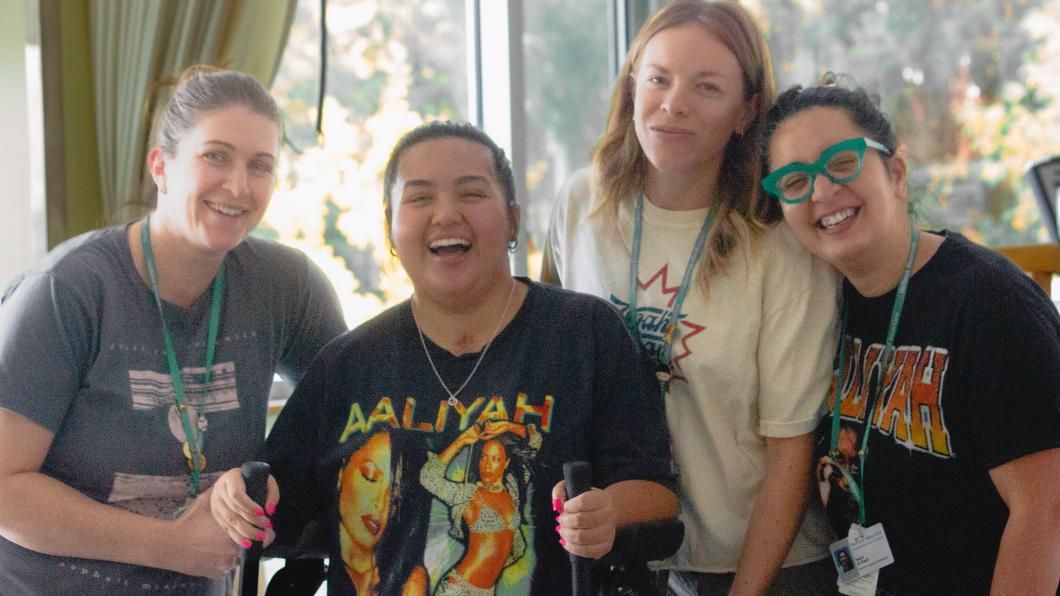
Kim Hurda, Carlie Thornber and Noor Al Radi (with client Julia, 19, centre) work together closely to support inpatients with complex medical problems at Holland Bloorview. Noor is a speech and language therapist, Carlie is a physiotherapist and Kim is an occupational therapist. “The team is a collaborative one, and it feels akin to magic at times,” Noor says. We talked about how they work together and the qualities they foster as a team.
BLOOM: How did you get into this field?
Kim Hurda: I worked for 15 years in private practice, and I’d wanted to work at Bloorview for a while as I’d volunteered here when I was doing my master’s. I wanted to work with children and in occupational therapy because you’re like a professional problem solver. You’re trying to figure out how to help kids do the things that they want or need to do.
Carlie Thornber: I come from an athletic background. I played soccer in the U.S. for school and in doing that, I found that I really liked athletics, the function of the body, and finding ways to move and be fit.
Soccer led me down a pathway of coaching. I coached in the U.S. for a while. I loved the aspect of teaching kids the sport of soccer and how to use their bodies. Then I was thinking about how I could use my background in biology and science and my love for athletics and it led me down this path of wanting to be a pediatric physio. One of my favourite jobs was as a summer camp counselor for the City of Oshawa. We ran sports camps and I loved it.
BLOOM: What about you Noor?
Noor Al Radi: I applied to three grad programs because I couldn’t quite decide: occupational therapy, policy, or speech and language. I remember my first day in class after picking speech and language, thinking: ‘Yep, this is right.’
BLOOM: How do the three of you collaborate?
Carlie Thornber: When children first come in a big part of our role is working towards client goals. I think what Kim, Noor, and I do nicely is talk about those goals and find ways that our assessment findings overlap with each other.
For example, motor planning is a very central issue that can be disrupted after a brain injury. I see it very physically with a child’s level of function. They have a lot of impairments with the way they move.
Then Noor takes that information and she finds that there are impairments in motor planning with speech articulation or language formation.
And Kim takes that and sometimes looks at feeding and motor planning.
So we take that main issue of the motor plan and decide whether we can kind of divide and conquer, or if we need to work together and give more repetition.
Noor Al Radi: On our unit there are many complex cases where there isn't a playbook, so we include our client as part of the team. We explain how what they’re doing in one therapy relates to what we’re doing in the next. That means they constantly feel supported. And if they’re having a day where they’re more tired, or need more motivation, we’re able to leverage some playfulness between the three of us.
Maybe we create a scavenger hunt or a game. Kim and I might work on executive functioning and the planning and building aspect of it. Then there's also the physical part, which is how do I move through space to be able to complete the task?
We try to involve the child at every point and make them feel like they're part of the collegial relationship that we have.
Kim Hurda: We incorporate all our goals into one giant activity that will take multiple sessions for the child to execute.
If we’re trying to find something motivating, kids often like the idea of pulling a prank on another staff member. So we may say: ‘We’re going to hide something on Carlie, and you have to go find it.' They think that’s really funny.
BLOOM: What qualities do you need to work well in a team?
Kim Hurda: A big one is flexibility. We all have our own goals but I find personally that it goes a lot better when I'm able to be flexible and pivot and incorporate what other people are working on too. We need to be flexible with the other clinicians but also with the client. You can go in with a plan, but that plan is not necessarily going to be executed. You have an idea, but you may have to pivot quite quickly based on a child’s mood or fatigue or lots of other factors.
BLOOM: Is there anything else about qualities you need to work well in a team?
Noor Al Radi: I’d say an imagination, especially since there’s no playbook for the approaches that may best support our clients.
Carlie Thornber: The word I was thinking of was open-mindedness. I’m a relatively new clinician. I’ve been working for three years and having this ability to learn what Kim and Noor do in their disciplines allows me to be able to better support the client, as opposed to just staying in my silo of what I do best.
Having our family team meetings and rounds is helpful. I’m able to listen to the scope of Kim's and Noor’s practices and understand what skills they have to help the client. Having that open-mindedness to accept different perspectives has really helped me so far.
BLOOM: Has your ability to work together changed over the last three years
Kim Hurda: Yes. We all sit together so it works well for collaboration. I’ll come back from a session and be able to share that a child is having a hard time doing this one skill. Then we can feed off that and talk about strategies. We talk to each other every day about progress and things we’re having difficulty with.
Being near to each other in our pods is extremely helpful.
Carlie Thornber: On that note, it’s these informal conversations I find the most helpful. Instead of trying to keep everything piled up in your brain to talk about once a week at rounds, or once every three weeks at a family team meeting, we can act on those informal conversations. If Noor has the same client right after me, or Kim does later in the day, they can address some of the day-to-day issues we talk about.
Noor Al Radi: We also join each other’s sessions to get a sense of what the other therapist is doing and a more holistic sense of the client, how their body is moving, and how that might affect one of their goals.
Our informal discussions are unbelievably valuable. They foster a better understanding of clients and build our relationship as clinicians. It takes a vulnerability to share your what-ifs and your thoughts and concerns. These conversations nurture our capacity to be open and think through challenging things that are happening.
BLOOM: What are the greatest challenges of working with children with complex medical needs?
Carlie Thornber: It’s competing priorities. For example, families come in with an overwhelming list of what it would take for them to feel able to take their child home. But what should come first on that list? What may be important to a family might be 20 steps down the line for us. So how do we prioritize that now with what we see and what we’re able to do?
Noor Al Radi: A lot of kids have complex needs that are multi-faceted, so there’s also more uncertainty. So triaging priorities is complicated by needing to support families through uncertainty.
How do we support families while also balancing our goals when we don’t quite know what’s coming up for a client?
Kim Hurda: It’s a huge challenge for sure. It’s an uncomfortable conversation with families. We need to be honest with them that we don’t know what things will look like long term.
What we do now is plan for the way a client is now. For example, for occupational therapy we deal with a lot of equipment. Families may question why they need to do all these funding applications for equipment when their child may not end up needing so much support later. But it’s always better to plan for more and need less than to have to plan for something at the last minute.
The other important thing is having the team be on the same page with these conversations, so the family gets the same message from all clinicians.
BLOOM: What are the joys of working with this population?
Kim Hurda: Seeing progress with clients is definitely tops for me.
Carlie Thornber: It’s the relationships I think that we get to build with these families. The bonds we get to have. We get to see families and experience their breadth of emotions from the time they're admitted to the time they're discharged.
We share in a lot of hope, a lot of sadness, a lot of heartbreak, and a lot of discouraging setbacks. Since we’re frontline clinicians, we celebrate the good things and share in the sadness and disappointment. When families come back and reflect on their time here, it’s very rewarding for us.
Noor Al Radi: Some of the people who come back to visit talk about seeing their ‘team.’ Many families express feeling like they had a full team behind them who understood their kids and developed goals that fed into one another.
The child who left walking got enough trunk support to be able to speak loudly and enough function in their hands to write notes to help them remember things. They saw how our goals worked together to build back not just a single vision of functionality, but a much larger, big-picture one where their child was seen as a whole.
BLOOM: How do you manage stress?
Kim Hurda: I don’t know if any of us are great at it, but we do rely on each other a lot as a team. So especially when a child isn’t making progress or we have a very challenging discharge, we talk to each other about how we’re feeling.
Carlie Thornber: It’s never this environment of trying to fix. You come to the team with a problem or something that’s bothering you or that feels heavy. They lean in and share the experience because they’ve had something similar happen. I think it’s having colleagues who can listen and respond in a compassionate way without a need to fix.
Noor Al Radi: We also put energy into building our clinician relationships. We bake things and bring them in for each other. We sit together at lunch. We make an effort to shore up our team which sets us up better in the difficult moments. We really value the team and put effort into maintaining it, building it and celebrating it.
BLOOM: What advice would you give a new therapist here?
Carlie Thornber: Be okay with not knowing. That was my biggest take away being the newest clinician on this team. Ask questions. People know a lot of stuff, even if they don't think they know a lot of stuff. So just ask. Have that vulnerability to be able to say I don’t know this answer.
The types of clients we see vary greatly. I’ve been here three years, and I still see clients with conditions or impairments I don’t know anything about. Asking people who have been here for a while or have more experience in one area, like the brain injury team or the orthopedic team, helps me to have a sounder clinical role with these clients.
Noor Al Radi: To add on to that, our sense of collaboration as a team extends beyond discipline or unit. We’re speaking to our colleagues across the spectrum, and I think that is something particularly special here.
BLOOM: If you could change one thing about how we support children with complex needs, what would it be?
Kim Hurda: It would be helpful for clients who will have very complex discharges to have a clear pathway to what the next step is.
Carlie Thornber: There are a lot of gaps in our system in Ontario. Sometimes home isn’t an option, or it isn’t the family’s choice, but families need a clear understanding of what our system can and can't offer. Where there’s a particular gap is the transition from pediatric services to those for adults who have complex medical needs. There just doesn’t seem to be an appropriate solution there.
Noor Al Radi: I would add the need for more mental health support. Obviously as a rehab facility, we’re thinking more about the physical. But we’re starting to see a bigger picture of physical and mental health. The parents of the kids who come in to our unit are experiencing huge changes in many aspects of their life.
I think having more inbuilt access to mental health supports for families and clients is important. Whether it’s about discharge or how their body has changed, or the future they envision. I think that would be incredibly helpful.
Like this content? Sign up for our monthly BLOOM e-letter.
