

Family helps autistic son move out, close to home
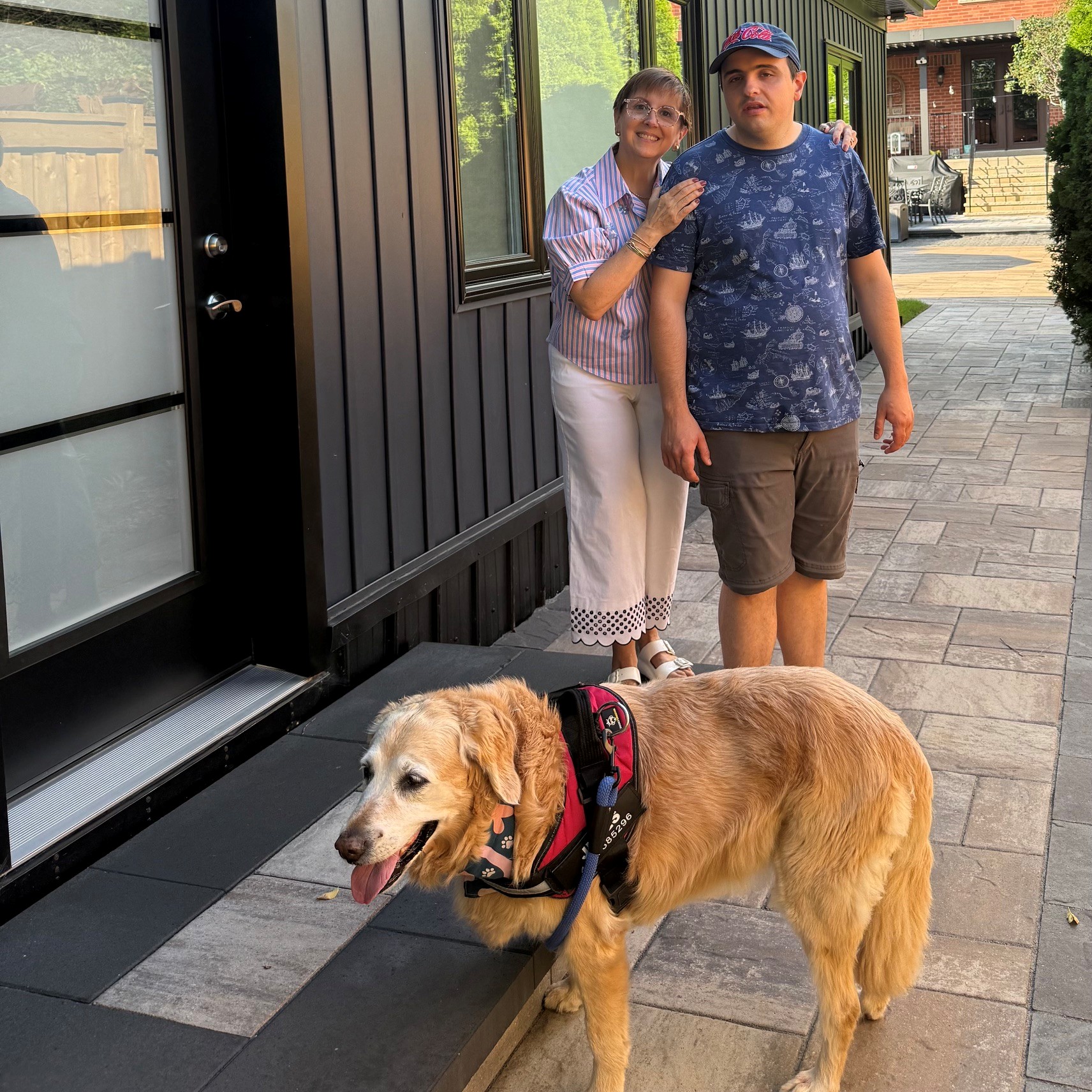
The Langills, including Tomas, above right, are one of my favourite Holland Bloorview families. We met decades ago in the hospital's nursery school Play and Learn.
By Louise Kinross
Tomas Langill, 30, has been enjoying his own home for the last month—an almost 1,000-square-foot modular house built in his parents’ deep backyard in Mississauga, Ont.
La Casita (little house in Spanish) was built so Tomas, who has autism, could have some independence from his family but still be close to parents Brett and Claudia and sister Nydia. It even has its own street number.
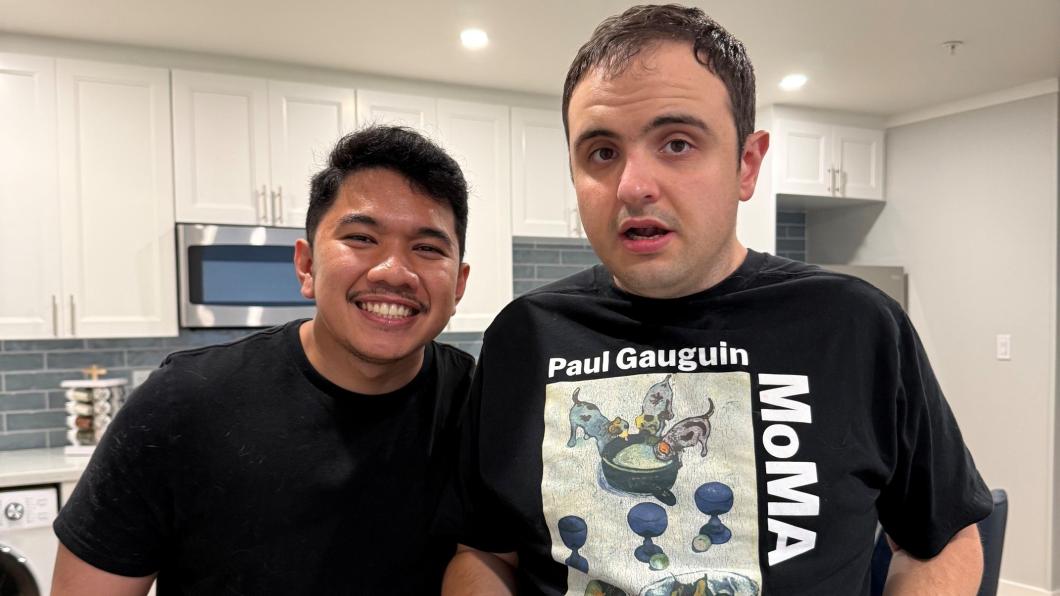
Tomas and his worker Patrick (above) sleep in the two-bedroom, two bathroom home, and have breakfasts and dinners there.
“We have the space and we love the idea that Tomas is close and that we know the setup, the home, and the people,” says father Brett. “Like a lot of parents, we worried about if we weren't here anymore, how would that look for Tomas and who would take care of him. Now if something were to happen to Claudia and I, this would still be his home.”
Claudia has had a vision of building a house for years, but in 2024 it became possible when Mississauga changed its zoning laws to allow “garden suites.”
Tomas, who loves car rides, trampolines and chocolate chip ice cream at Baskin Robbins, has settled into his new place better than expected, Brett says. When Patrick takes a weekend off, Tomas hangs out at his parents’ place.
The Langills initially met with a builder engineer, but were a bit overwhelmed at the prospect of a hiring an architect and starting from scratch.
Then they learned about modular homes. “They build the house in the factory and then they take it apart and reassemble it like a LEGO set on your property,” Brett says. “They told us what it would cost—about $300,000—and never deviated from that, even when there were changes in plans.” Other costs included $80,000 to prepare the site and about $100,000 to clean up and re-landscape it.
A general contractor oversaw the entire project, which included getting permits; clearing the area and prepping it with a concrete slab; running hydro, sewage, and water from the main house; and putting in La Casita’s own private patio, grass garden and Tomas’s swing.
The fire department insisted on a second water line from the main home to power a sprinkler system.
Getting the permits took over a year and was the most challenging part of the project, Brett says. “Other than that, everything exceeded our expectations all along the way.”
The family was able to get permission from a school behind their property to bring in big equipment, including a crane, from the back.
The project began in mid-December and by mid-March was largely complete. The house has soundproofing and one accessible bathroom.
“Tomas isn’t able to tell us what he thinks of the house, but he quickly adopted the routine when coming home of walking past our house to his own,” Brett says. At a recent barbecue, "Tomas smiled while he and I showed La Casita to guests,” Brett says. “He’s been sleeping well and eating well and hasn’t missed a beat.”
To help prepare Tomas, the family hired the worker who would live in the home a year ago.
“We talked about building his home, and that this was where Tomas and Patrick would sleep,” Brett says. "Patrick is new to the country and in the process of applying for a work permit. We're sponsoring him and his goal is to become a Canadian citizen." It's a difficult and costly process with no guarantees. “The government has made it harder to come here as a caregiver,” Brett notes.
Tomas spends his days doing activities with several workers. “Over time we’ve found three or four people who love Tomas as much as we do, and some live nearby. It’s a small, family community effort.”
Brett says they’ve benefited from hiring middle-aged workers who are happy to do the work and won’t be moving on quickly, as often happens with young adults. " For many years we had one person and they'd be younger. And then one day they'd say 'I'm going to go to nursing school,' which of course was a great idea. But then we had no one."
He acknowledges that building a garden suite is out of reach for most families. “First you have to have a large enough lot, and second you need the financial resources.”
The family was unable to get grants to help cover the costs. They did apply for a tax-credit for a multi-generational home, but after filling out the paperwork, the Canada Revenue Agency “is challenging it,” Brett says. “Also the tax credit was advertised as up to $50,000. But now we’ve done the paperwork, it would only apply to $7,000, if we get it approved,” he says.
“We also heard about getting some of the HST back on this kind of home, but we’ve had to hire a professional to help us with this, and you don’t get it all back. I’ll believe it when I see it.”
Brett says the family is grateful they were able to build the home. "This was Claudia's dream. We feel absolutely at peace knowing we have a really good thing in place. The question of where Tomas would live had weighed on us for many years.”
Resimate Inc. oversaw the project and the accessory dwelling unit builder was Axe Living. In this photo of Claudia, Tomas and dog Jules, you can see the new modular home with the main house behind. Like this content? Sign up for our monthly BLOOM e-letter.