


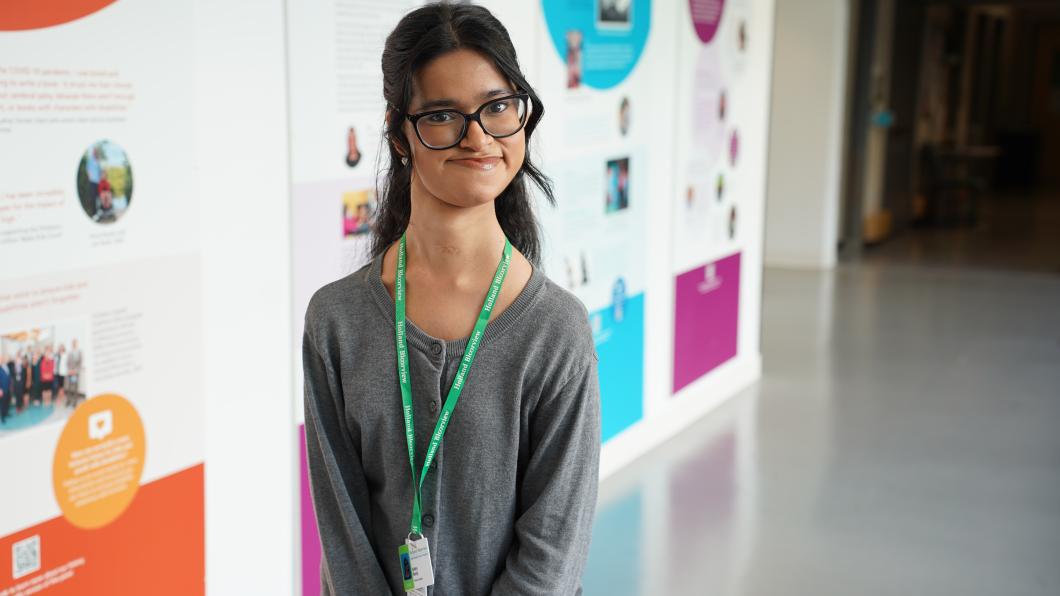
At 10, a patient dreamed of wearing a staff lanyard. Now she does
Photo by William Lam
In 2018, Safira Ramji was a healthy 10-year-old when she contracted a life-threatening virus. After 40 days in SickKids’ intensive care unit, she came to Holland Bloorview for nine months of inpatient rehab. She was unable to walk, talk or eat. Safira is now a second-year finance student at the University of Toronto Scarborough doing a co-op placement in Accounts Payable at Holland Bloorview. We spoke about her experiences here.
BLOOM: Can you describe why you first came here?
Safira Ramji: When I was 10, I was perfectly healthy. Then one day, I woke up and my arm was numb. It wasn't moving. So my parents took me to SickKids and I was admitted. Two days later I stopped breathing and I spent 40 days in the ICU.
BLOOM: What was the diagnosis you were given?
Safira Ramji: I had a form of Enterovirus D68, which is the strain, and the condition is called acute flaccid myelitis. It attacked my spinal cord. It presents as the cold flu virus and then gradually worsens. I was admitted here to complex continuing care.
BLOOM: What was your condition when you first came?
Safira Ramji: I had a tracheotomy and was on a ventilator 24 hours a day. I wasn’t able to walk, talk, eat, or basically do anything. Then I started physiotherapy, occupational therapy and speech, and started to recover.
BLOOM: What were the greatest challenges during that nine months?
Safira Ramji: I would say finding the strength to show up every day and want to do really hard things. Every day they try to get you to do something more than you did the day before. I found it a bit challenging to try new things when you don’t know if you’ll be able to do them or how they’re going to go.
BLOOM: How did you cope with that mentally?
Safira Ramji: Where I found joy was in Bloorview School, because I was in Grade 6 and I really loved school. My favourite subject was math, and I loved going to school and learning. For my whole stay I found a way to go to school in the morning and then do my therapies in the afternoon. I was able to stay on track with my education, as well as do my therapies and get stronger, so I could go to school in person in Grade 7.
BLOOM: How could you do your schoolwork since you said you had lost many abilities?
Safira Ramji: I had an amazing teacher and an amazing educational assistant. My teacher was Lorna Jones and my EA was Busi Tshuma.
I had use of one arm, so they made everything online so that I could do it with one hand. I couldn’t write or draw but we used an iPad that I could do math and reading games on. It was really interactive.
BLOOM: How did you communicate then?
Safira Ramji: When I came from SickKids, I was using a letter board to point to the letters to spell stuff out. Because I had a trache, I couldn’t talk. Eventually with my speech therapist, I got a speaking valve. Then I was able to start talking a little bit and learned how to talk again.
BLOOM: It sounds like our onsite school gave you a sense of stability.
Safira Ramji: Yes, it gave me a normal routine.
BLOOM: How did your family cope during those nine months you were here?
Safira Ramji: I was lucky that I had both my parents with me. I’m an only child. My parents would take turns coming. My dad worked in the daytime and came in the evening. My mom was with me pretty much all day. They really supported me and gave me motivation to keep going with therapies to learn how to walk, talk and eat. I wasn’t doing any of that, and I didn’t think it was possible. They gave me hope. They said you can do anything you put your mind to. Even if it's hard, you can still do it.
BLOOM: Were clinicians uncertain about your prognosis?
Safira Ramji: At the beginning I was told that I would go home on a ventilator with a trache and would never walk again. I would have to go home with a wheelchair. On the day I was discharged I walked out, and they had already ordered the wheelchair.
BLOOM: Were there approaches therapists used that helped you?
Safira Ramji: Yes. For example, I had to wean off my ventilator slowly. You do it for one hour without the vent one day, and then the next day you try two hours, and you keep going. The respiratory therapists really helped me with that. There was one I remember who played cards with me.
BLOOM: Did that help distract you? Because I assume without distraction you would get worried about your breathing.
Safira Ramji: Yes, it was a really good distraction. We also played board games and did paintings.
BLOOM: Was there any care during your stay you didn’t find helpful?
Safira Ramji: Probably when they present the worst case to you, like saying we would need to move homes. I wish that they could have been less certain about what might happen.
BLOOM: Do you have any advice for kids who are currently doing rehab here?
Safira Ramji: I would say to all the children: You are stronger than you think and you are braver than you know.
You have to show up. Showing up is the first thing. If you show up, that's half the job done. And then really listen to what the clinicians are saying. They know how to best support you. For example, my physio would give me exercises and I knew I had to do them on my own.
BLOOM: Do you have ideas for how we could make the inpatient experience better?
Safira Ramji: Yes, I would say more interactive activities for people of all abilities. There was swimming and sports but in complex continuing care, if you have a trache, you can’t go in the water. I felt I was missing out on a lot of activities. So maybe if they could adapt more of them.
BLOOM: What was your transition home like?
Safira Ramji: I was discharged in April of 2019 from inpatient to the day program. By then I was walking but it was still really hard. I had a trache and a neck brace. I was still struggling. In June I was discharged from the day program and I spent the summer building up my stamina and getting strong. I started swimming, walking, doing more therapy and then I went back to a new middle school in September.
BLOOM: How did that go?
Safira Ramji: It was really challenging because everything was new. I had a trache so I had to have a nurse with me at all times, which made it hard to make friends. I felt like I was lucky that everything was very inclusive. Everyone was nice and kind, but I don’t think I was strong enough to be my best self at that point. Then COVID hit in March and I was at home.
BLOOM: What was your experience doing school from home?
Safira Ramji: I had only gone six months in the classroom so I feel like I missed out on more time there in Grade 7. But for me being at home was great because I was able to get stronger going to therapy and exercising and really focus on myself. I did Grade 8 online because it still wasn’t safe to go to school.
BLOOM: Then you were back in school for high school?
Safira Ramji: Yes. I had a really good high school experience. I loved my school, my friends and my teachers. I got really lucky that I had worked so hard to get strong so I could enjoy my high school years.
BLOOM: What are you doing now?
Safira Ramji: I’m currently a second-year student at the University of Toronto Scarborough. I’m studying management and finance. This is a co-op semester. I started here at Bloorview at the end of August and it’s four-and-a-half months.
BLOOM: You’re working in Accounts Payable?
Safira Ramji: Yes, working with numbers. I’m really enjoying it.
Ever since I was an inpatient, I had a dream of coming back to Bloorview as an employee. I would see people with the green lanyards and I was like: ‘Yes, one day that will be me.’
I was really excited to do my first co-op term in a place that means so much to me. Being able to contribute to something that is supporting kids really makes me happy.
BLOOM: I think you said when you were first here as a 10-year-old that math was your favourite subject. It sounds like that’s always been a passion and something you want to pursue. What are your hopes for the future?
Safira Ramji: I’m going back to school in January and will finish up my degree. Then I hope to work in finance supporting hospitals or not-for-profits. Hopefully I’ll be back at Bloorview in another capacity.
BLOOM: What’s most challenging about this placement?
Safira Ramji: I would say learning the new systems like Meditech. Once you get used to it it’s okay.
BLOOM: What has been the greatest joy of working here, given you were once an inpatient?
Safira Ramji: There are a lot of things. Working with the finance team is super. They’re really welcoming and always happy to chat and teach you new things. I feel the experience I gained from this will stay with me for a long time.
I feel like we’re all contributing to making the world a more accessible place. To be working here directly, having an impact, I think is the greatest joy.
BLOOM: When you’re at school where do you live?
Safira Ramji: I live on campus. Living independently was always a goal of mine. In my first year I did get an accessible room. I fought for a lot of things, and I think it’s up to the individual. You have to stand up for yourself and advocate for yourself.
BLOOM: How did you find that voice?
Safira Ramji: Do you know what? When I was an inpatient, I had an amazing child life specialist Amarens. It was her energy and her optimism. She made it seem like everything would be okay. And she always told me to find your voice and speak up.
BLOOM: Is there anything you would do to improve our co-op student experience?
Safira Ramji: I feel more disability inclusion would be beneficial. Because sometimes people with disabilities aren’t given the same chance.
BLOOM: So if we more actively recruited people with disabilities for those placements?
Safira Ramji: Yes, especially since the building is 100 per cent accessible and it's a place where people with disabilities can have a really good employment experience.
Like this content? Sign up for our monthly BLOOM e-letter or watch our A Family Like Mine film series.
